Birdr

Thrush Nightingale vs Bluethroat

Luscinia luscinia versus Luscinia svecica

Play a quiz with Thrush Nightingale and Bluethroat
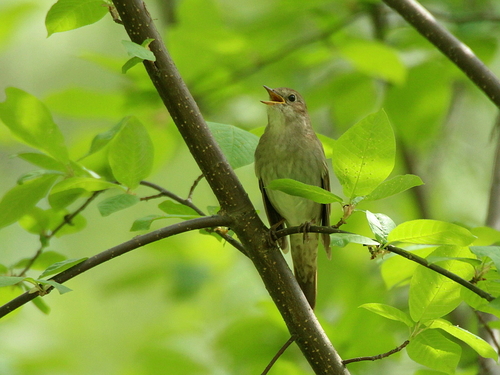
Thrush Nightingale (Luscinia luscinia) Thrush Nightingale
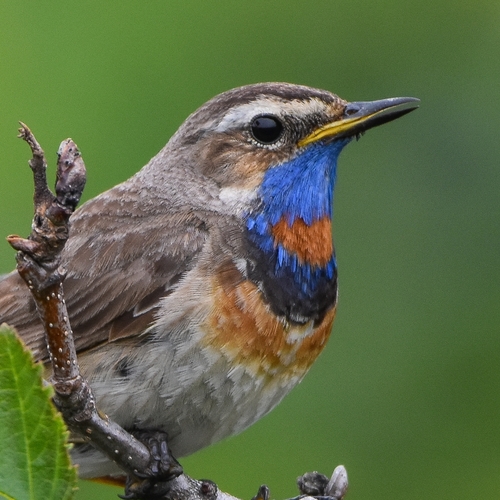
Bluethroat (Luscinia svecica) Bluethroat

Media

Loading…

In short

The Thrush Nightingale (Luscinia luscinia) and the Bluethroat (Luscinia svecica) are both small, ground-dwelling birds of the Old World Flycatchers family. The Bluethroat is distinguished by its striking blue throat patch, while the Thrush Nightingale is more uniformly brown. Both species can be found in similar habitats, but their vocalizations and plumage provide reliable identification cues.

Identification tips

1. Look for the blue throat patch on the Bluethroat, especially in males. 2. Note the overall brown plumage of the Thrush Nightingale. 3. Listen for the song: the Thrush Nightingale's is more melodious, while the Bluethroat's includes mimicry. 4. Observe behavior: the Bluethroat often flicks its tail and may be more visible in open areas.

Size

Both species are similar in size, but the Bluethroat may appear slightly more compact due to its shorter tail.

Plumage

The Thrush Nightingale is mostly brown with a slightly paler underbelly, lacking any striking color features. In contrast, the Bluethroat, especially males, has a distinctive blue throat with a central spot that can be red or white depending on the subspecies. Females and nonbreeding males of the Bluethroat may show a more subdued version of this pattern.

Behaviour

Both species are often seen foraging on the ground or low in vegetation. The Bluethroat may be more conspicuous due to its frequent tail-flicking and more upright posture.

Habitat

Both species inhabit dense, shrubby areas, often near water. The Thrush Nightingale prefers deciduous forests and thickets, while the Bluethroat is more commonly found in marshy areas and reed beds.

Voice

The Thrush Nightingale has a rich, melodious song, often delivered from a hidden perch. The Bluethroat's song is varied and includes mimicry, often sung from an exposed perch.

Submit a better description

Use the same sections as the comparison. Your text is published immediately.

The Thrush Nightingale (Luscinia luscinia) and the Bluethroat (Luscinia svecica) are both small, ground-dwelling birds of the Old World Flycatchers family. The Bluethroat is distinguished by its striking blue throat patch, while the Thrush Nightingale is more uniformly brown. Both species can be found in similar habitats, but their vocalizations and plumage provide reliable identification cues.

1. Look for the blue throat patch on the Bluethroat, especially in males. 2. Note the overall brown plumage of the Thrush Nightingale. 3. Listen for the song: the Thrush Nightingale's is more melodious, while the Bluethroat's includes mimicry. 4. Observe behavior: the Bluethroat often flicks its tail and may be more visible in open areas.

Both species are similar in size, but the Bluethroat may appear slightly more compact due to its shorter tail.

The Thrush Nightingale is mostly brown with a slightly paler underbelly, lacking any striking color features. In contrast, the Bluethroat, especially males, has a distinctive blue throat with a central spot that can be red or white depending on the subspecies. Females and nonbreeding males of the Bluethroat may show a more subdued version of this pattern.

Both species are often seen foraging on the ground or low in vegetation. The Bluethroat may be more conspicuous due to its frequent tail-flicking and more upright posture.

Both species inhabit dense, shrubby areas, often near water. The Thrush Nightingale prefers deciduous forests and thickets, while the Bluethroat is more commonly found in marshy areas and reed beds.

The Thrush Nightingale has a rich, melodious song, often delivered from a hidden perch. The Bluethroat's song is varied and includes mimicry, often sung from an exposed perch.

Discard your changes?

You have unsaved edits. If you leave now, those changes will be lost.

Thrush Nightingale · Bluethroat · My Tricky Birds