Birdr

Townsend's Storm-Petrel vs Band-rumped Storm-Petrel

Hydrobates socorroensis versus Hydrobates castro

Play a quiz with Townsend's Storm-Petrel and Band-rumped Storm-Petrel
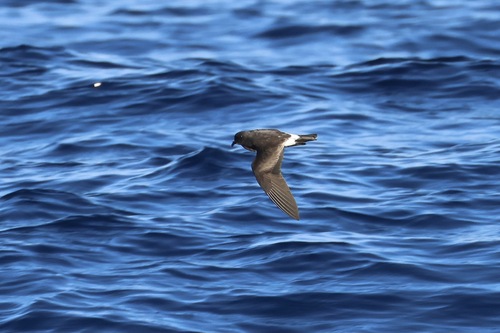
Townsend's Storm-Petrel (Hydrobates socorroensis) Townsend's Storm-Petrel
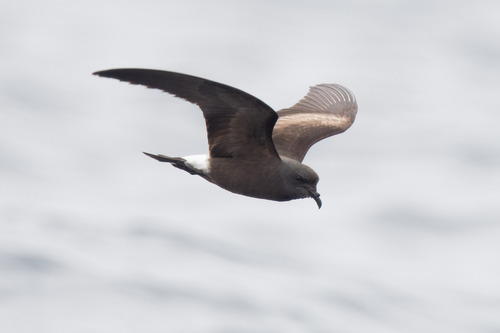
Band-rumped Storm-Petrel (Hydrobates castro) Band-rumped Storm-Petrel

Media

Loading…

In short

Townsend's Storm-Petrel and Band-rumped Storm-Petrel are challenging to distinguish at sea, but differences in flight style and subtle plumage details can help. Townsend's tends to have a more fluttery flight compared to the steadier, more bounding flight of Band-rumped. Both species are similar in size and general coloration, making identification difficult without close observation.

Identification tips

Size

Both species are similar in size, making structural differences more critical for identification.

Plumage

Townsend's Storm-Petrel generally has a darker overall plumage with less contrast between the upperparts and underparts. Band-rumped Storm-Petrel may show slightly lighter underparts, but this is subtle and not always reliable.

Behaviour

Townsend's Storm-Petrel exhibits a more fluttery flight pattern, while Band-rumped Storm-Petrel has a steadier, more bounding flight. Both species feed by seizing prey from the ocean surface.

Habitat

Both species are pelagic and are often seen far out at sea, making them difficult to observe from land. Townsend's Storm-Petrel is known to disperse north and south from southern California.

Submit a better description

Use the same sections as the comparison. Your text is published immediately.

Townsend's Storm-Petrel and Band-rumped Storm-Petrel are challenging to distinguish at sea, but differences in flight style and subtle plumage details can help. Townsend's tends to have a more fluttery flight compared to the steadier, more bounding flight of Band-rumped. Both species are similar in size and general coloration, making identification difficult without close observation.

  • Flight style: Townsend's has a fluttery flight; Band-rumped is steadier and more bounding.
  • Plumage: Look for subtle differences in the contrast of upperparts and underparts.
  • Location: Consider geographic range, especially if near southern California where Townsend's may be more common.
  • Behavior: Observe feeding behavior; both species seize prey from the surface, but flight style can be distinctive.

Both species are similar in size, making structural differences more critical for identification.

Townsend's Storm-Petrel generally has a darker overall plumage with less contrast between the upperparts and underparts. Band-rumped Storm-Petrel may show slightly lighter underparts, but this is subtle and not always reliable.

Townsend's Storm-Petrel exhibits a more fluttery flight pattern, while Band-rumped Storm-Petrel has a steadier, more bounding flight. Both species feed by seizing prey from the ocean surface.

Both species are pelagic and are often seen far out at sea, making them difficult to observe from land. Townsend's Storm-Petrel is known to disperse north and south from southern California.

Discard your changes?

You have unsaved edits. If you leave now, those changes will be lost.

Townsend's Storm-Petrel · Band-rumped Storm-Petrel · My Tricky Birds