Birdr

Tree Pipit vs Buff-bellied Pipit

Anthus trivialis versus Anthus rubescens

Play a quiz with Tree Pipit and Buff-bellied Pipit
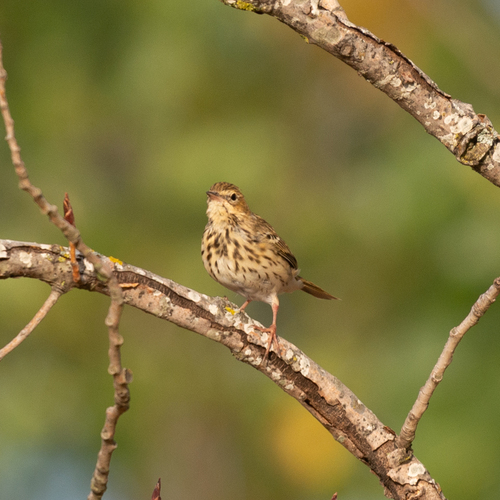
Tree Pipit (Anthus trivialis) Tree Pipit
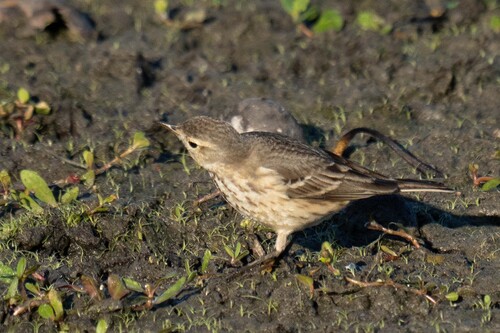
Buff-bellied Pipit (Anthus rubescens) Buff-bellied Pipit

Media

Loading…

In short

Tree Pipit and Buff-bellied Pipit can be distinguished by their habitat preferences and subtle plumage differences. Tree Pipit is more olive-toned above and has a bolder supercilium, while Buff-bellied Pipit is more buff-brown and less olive. Vocalizations differ, with Tree Pipit having a distinctive song and call.

Identification tips

Size

Both species are similar in size, around 14–15 cm in length.

Plumage

Tree Pipit has an olive-brown upperpart with a bold supercilium and thinner flank streaks. Buff-bellied Pipit is buff-brown above, with a less prominent supercilium and a more uniform appearance.

Behaviour

Both species forage on the ground for invertebrates, but Buff-bellied Pipit is more likely to be seen in open habitats like beaches and mudflats.

Habitat

Tree Pipit prefers woodland edges and open forests, while Buff-bellied Pipit is found in open habitats such as tundra, beaches, and agricultural fields.

Voice

Tree Pipit's song is a series of trills and repeated notes, ending with 'seee-er' sounds. Its call is a drawn-out 'tseep'. Buff-bellied Pipit's vocalizations are not as prominently described here.

Submit a better description

Use the same sections as the comparison. Your text is published immediately.

Tree Pipit and Buff-bellied Pipit can be distinguished by their habitat preferences and subtle plumage differences. Tree Pipit is more olive-toned above and has a bolder supercilium, while Buff-bellied Pipit is more buff-brown and less olive. Vocalizations differ, with Tree Pipit having a distinctive song and call.

  • Habitat: Tree Pipit in wooded areas; Buff-bellied Pipit in open fields and shores.
  • Plumage: Look for olive tones and bold supercilium in Tree Pipit.
  • Vocalization: Listen for Tree Pipit's trilling song.
  • Behavior: Observe foraging style; Buff-bellied Pipit often in open areas.

Both species are similar in size, around 14–15 cm in length.

Tree Pipit has an olive-brown upperpart with a bold supercilium and thinner flank streaks. Buff-bellied Pipit is buff-brown above, with a less prominent supercilium and a more uniform appearance.

Both species forage on the ground for invertebrates, but Buff-bellied Pipit is more likely to be seen in open habitats like beaches and mudflats.

Tree Pipit prefers woodland edges and open forests, while Buff-bellied Pipit is found in open habitats such as tundra, beaches, and agricultural fields.

Tree Pipit's song is a series of trills and repeated notes, ending with 'seee-er' sounds. Its call is a drawn-out 'tseep'. Buff-bellied Pipit's vocalizations are not as prominently described here.

Discard your changes?

You have unsaved edits. If you leave now, those changes will be lost.

Tree Pipit · Buff-bellied Pipit · My Tricky Birds