
Tropical Mockingbird vs Northern Mockingbird
Mimus gilvus versus Mimus polyglottos
Play a quiz with Tropical Mockingbird and Northern Mockingbird
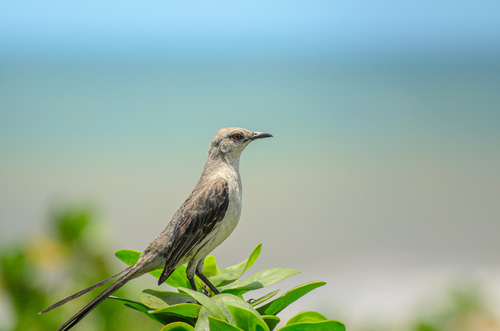 Tropical Mockingbird
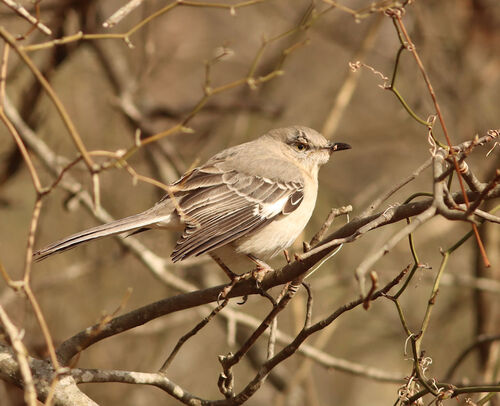 Northern Mockingbird
In short
The most reliable field mark between Tropical Mockingbird and Northern Mockingbird is the pattern and contrast of their wings and tail in flight, especially in juveniles and immatures. Northern Mockingbird shows bold white wing patches and white outer tail feathers that flash conspicuously in flight, while Tropical Mockingbird has two white wing bars and white feather tips on a long dark tail, but lacks the large white wing patch. Juvenile plumage also differs: Northern Mockingbird juveniles are heavily streaked above and below, while Tropical Mockingbird juveniles are browner with dusky streaks only on the chest and flanks. Structure and bill shape can help, but expect overlap; context and habitat are only modestly helpful where ranges overlap.
Identification tips
- Juvenile plumage: Northern Mockingbird juveniles have bold streaks on the back and chest, and a grayish or greenish iris. Tropical Mockingbird juveniles are browner, with dusky streaks only on the chest/flanks, and lack the back streaks. This is most useful in late summer and fall.
- Wing pattern in flight (all ages): Northern Mockingbird shows a large, conspicuous white wing patch and white outer tail feathers that flash when the bird flies or displays. Tropical Mockingbird lacks the large white wing patch, instead showing two white wing bars and white edges to the flight feathers—this is the single best mark in flight.
- Tail pattern: Both species have long tails, but Northern Mockingbird's white outer tail feathers are more prominent and contrast strongly with the black central feathers. Tropical Mockingbird's tail is dark with white tips but lacks the same bold white outer tail feathers.
- Supercilium and face: Tropical Mockingbird has a clear whitish supercilium (eyebrow) and a dark stripe through the eye, giving a more marked face. Northern Mockingbird's face is plainer, with less contrast around the eye.
- Bill shape: Both have slim, blackish bills, but Tropical Mockingbird's is slightly more downcurved and, in some subspecies, heavier and longer. This is subtle and only helpful with direct comparison or experience.
- Leg color: Both species have long, dark legs; this is not a useful separator.
- Overall color tone: Tropical Mockingbird is generally paler above and below, with a more silvery-gray tone and less contrast between upper- and underparts. Northern Mockingbird is slightly darker above and whiter below, but this is variable and unreliable.
- Behavioral displays: Northern Mockingbird often wing-flashes, spreading its wings to show the white patches. Tropical Mockingbird may display, but the lack of a bold white patch makes it less obvious.
- Habitat: Both species use open, human-modified habitats. In overlap zones, do not rely on habitat alone for ID.
- Iris color: Northern Mockingbird usually has a light green-yellow or yellow iris (sometimes orange), while Tropical Mockingbird's eye color varies by subspecies and is not a strong field mark.
- Size: Both are similar in size; some Tropical Mockingbird subspecies are larger, but overlap is extensive and not reliable for field separation.
- Voice: Both are accomplished mimics with variable songs; unless you know local dialects, do not use voice for separation.
- Seasonal context: In areas where only one species is expected, out-of-range records should be scrutinized with care, but vagrancy and escapes do occur.
- Subspecies variation: Some Tropical Mockingbird subspecies (e.g., M. g. magnirostris) are notably larger and heavier-billed, but most field encounters will not allow for subspecies-level ID.
- Pitfalls: Beware of worn or molting birds, which may show reduced wing markings or faded plumage, making separation more difficult. Focus on structure and flight pattern in these cases.
Size
Both species are similar in overall size and proportions, with Northern Mockingbird measuring 20.5–28 cm in length and a typical body mass of about 48 g. Tropical Mockingbird is 23–25.5 cm long, with subspecies variation but generally similar mass (precise mass not provided). Males of both species may be slightly larger than females, but this is not a reliable field mark. Tail and wing lengths are comparable, though some Tropical Mockingbird subspecies (e.g., M. g. magnirostris, M. g. tolimensis) are notably larger and heavier-billed.
Plumage
Juvenile and immature birds are best separated by their upperpart and underpart streaking: Northern Mockingbird juveniles have streaks on the back and bold spots and streaks on the chest, plus a gray or grayish-green iris. Tropical Mockingbird juveniles are browner overall, with dusky streaks limited to the chest and flanks, and lack the bold back streaks. In flight, adult Northern Mockingbirds show a prominent white wing patch and white outer tail feathers, creating a striking contrast; their wing bars are parallel and connect near the white patch. Tropical Mockingbird adults have two white wing bars and white edges to the flight feathers, but do not show a large white wing patch—this is a key difference in flight. Both have gray upperparts and pale underparts, but Tropical Mockingbird has a more pronounced whitish supercilium and a dark eye-stripe, while Northern Mockingbird's face is plainer. Bill color is similar, though Tropical Mockingbird's is slightly more downcurved and, in some subspecies, heavier.
Behaviour
Both species are aggressive and territorial, often seen foraging on the ground or low in vegetation. Northern Mockingbirds are known for their wing-flashing display—spreading and flashing their white wing patches while foraging or displaying. Tropical Mockingbirds may also display, but lack the bold white wing patch, so the behavior is less visually striking. Both species are omnivorous and opportunistic, feeding on insects, fruits, and occasionally small vertebrates or eggs. Both defend territories vigorously, including against other species.
Habitat
Northern Mockingbird is widespread in North America, including urban, suburban, and rural areas, and is also present in parts of the Caribbean and Hawaii. Tropical Mockingbird is found from southern Mexico through Central America and much of South America, as well as many Caribbean islands. Both species favor open habitats, such as scrub, savanna, parks, and gardens, and avoid dense forest and mangroves. Where their ranges overlap (e.g., parts of the Caribbean, northern Central America), both may be found in similar habitats, so habitat alone is not a reliable separator.
Voice
Both species are excellent mimics with varied, complex songs. The notes do not provide enough detail to reliably separate them by voice in the field. Both sing long, varied sequences of notes, trills, and imitations. Unless you are familiar with subtle regional differences, vocalization is not a dependable field mark for separation.
Tropical Mockingbird · Northern Mockingbird · My Tricky Birds