Birdr

Tuxtla Quail-Dove vs White-faced Quail-Dove

Zentrygon carrikeri versus Zentrygon albifacies

Play a quiz with Tuxtla Quail-Dove and White-faced Quail-Dove
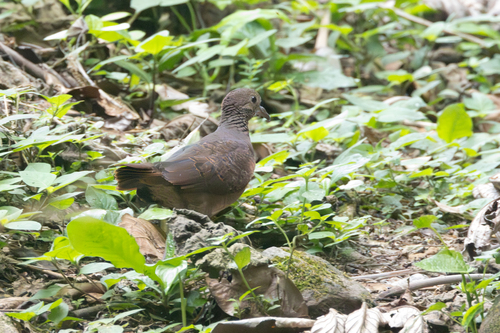
Tuxtla Quail-Dove (Zentrygon carrikeri) Tuxtla Quail-Dove
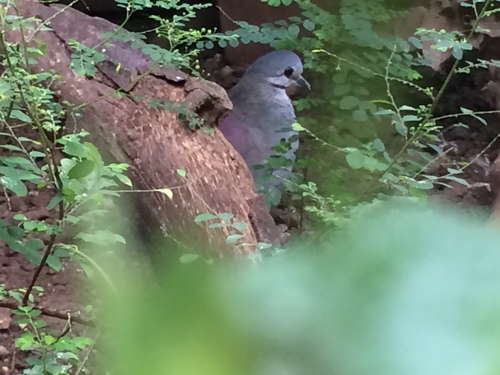
White-faced Quail-Dove (Zentrygon albifacies) White-faced Quail-Dove

Media

Loading…

In short

The Tuxtla Quail-Dove and White-faced Quail-Dove are both part of the Zentrygon genus, making them structurally similar. Key differences lie in their plumage: the Tuxtla Quail-Dove has a more uniform coloration, while the White-faced Quail-Dove features a distinctive pale face and purplish mantle. Habitat preferences also differ, with the Tuxtla Quail-Dove restricted to specific volcanic regions.

Identification tips

  1. Look for the pale face and purplish mantle of the White-faced Quail-Dove. 2. Note the uniform coloration of the Tuxtla Quail-Dove. 3. Consider habitat: the Tuxtla is restricted to volcanic areas, while the White-faced can be found in various forest types. 4. Use caution with vocalizations as they are poorly documented for both species.

Size

Both species are similar in size, typical of quail-doves, with no significant size difference noted.

Plumage

The Tuxtla Quail-Dove has a more uniform coloration, whereas the White-faced Quail-Dove is characterized by a pale face, purplish cast to the mantle, and dark 'furrows' on the neck. The White-faced Quail-Dove also lacks a dark malar stripe and has a paler breast.

Behaviour

Behavioral differences are not well-documented, but both species likely exhibit typical quail-dove behaviors such as ground foraging and secretive movements.

Habitat

Tuxtla Quail-Dove is found in a very restricted range on two volcanoes, while the White-faced Quail-Dove inhabits humid evergreen and pine forests, as well as cloud forests in Mexico.

Voice

Vocalization details are not well-documented for either species, making it difficult to use calls as a reliable field mark.

Submit a better description

Use the same sections as the comparison. Your text is published immediately.

The Tuxtla Quail-Dove and White-faced Quail-Dove are both part of the Zentrygon genus, making them structurally similar. Key differences lie in their plumage: the Tuxtla Quail-Dove has a more uniform coloration, while the White-faced Quail-Dove features a distinctive pale face and purplish mantle. Habitat preferences also differ, with the Tuxtla Quail-Dove restricted to specific volcanic regions.

  1. Look for the pale face and purplish mantle of the White-faced Quail-Dove. 2. Note the uniform coloration of the Tuxtla Quail-Dove. 3. Consider habitat: the Tuxtla is restricted to volcanic areas, while the White-faced can be found in various forest types. 4. Use caution with vocalizations as they are poorly documented for both species.

Both species are similar in size, typical of quail-doves, with no significant size difference noted.

The Tuxtla Quail-Dove has a more uniform coloration, whereas the White-faced Quail-Dove is characterized by a pale face, purplish cast to the mantle, and dark 'furrows' on the neck. The White-faced Quail-Dove also lacks a dark malar stripe and has a paler breast.

Behavioral differences are not well-documented, but both species likely exhibit typical quail-dove behaviors such as ground foraging and secretive movements.

Tuxtla Quail-Dove is found in a very restricted range on two volcanoes, while the White-faced Quail-Dove inhabits humid evergreen and pine forests, as well as cloud forests in Mexico.

Vocalization details are not well-documented for either species, making it difficult to use calls as a reliable field mark.

Discard your changes?

You have unsaved edits. If you leave now, those changes will be lost.

Tuxtla Quail-Dove · White-faced Quail-Dove · My Tricky Birds