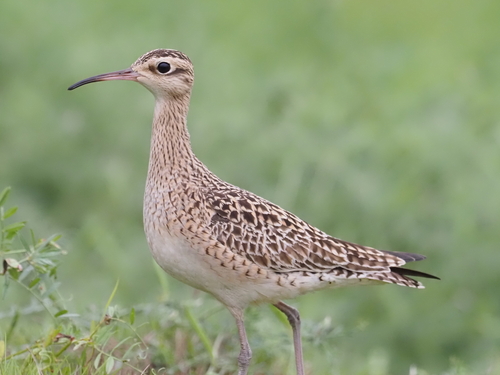
Upland Sandpiper vs Little Whimbrel
Bartramia longicauda versus Numenius minutus
Play a quiz with Upland Sandpiper and Little Whimbrel

Upland Sandpiper
Little Whimbrel
In short
The Upland Sandpiper and Little Whimbrel can be distinguished by their bill shape and size. The Upland Sandpiper has a short, straight bill, while the Little Whimbrel features a longer, slightly decurved bill. Both species are similar in overall brownish plumage, but their structural differences are key for identification.
Identification tips
- Bill Shape: Look for the short, straight bill of the Upland Sandpiper versus the longer, slightly decurved bill of the Little Whimbrel. 2. Size and Posture: Note the slightly larger size and upright posture of the Upland Sandpiper. 3. Habitat: Consider the habitat; Upland Sandpipers are more likely in grasslands, while Little Whimbrels are found in wetlands and coastal areas during migration. 4. Vocalizations: Listen for the Upland Sandpiper's melodic calls, especially in breeding areas.
Size
The Upland Sandpiper is slightly larger than the Little Whimbrel, with a more upright posture.
Plumage
Both species have mottled brown plumage, but the Upland Sandpiper has a more uniform appearance with less distinct streaking compared to the Little Whimbrel, which may show more contrast in its plumage.
Behaviour
Upland Sandpipers are often seen standing upright in grasslands, while Little Whimbrels are more likely to be observed in flocks during migration.
Habitat
Upland Sandpipers prefer open grasslands and fields, often near airfields, while Little Whimbrels are associated with taiga and steppe regions, migrating through wetlands and coastal areas.
Voice
The Upland Sandpiper has a distinctive, melodic call often heard during breeding season, while the Little Whimbrel's calls are less frequently noted in field guides.