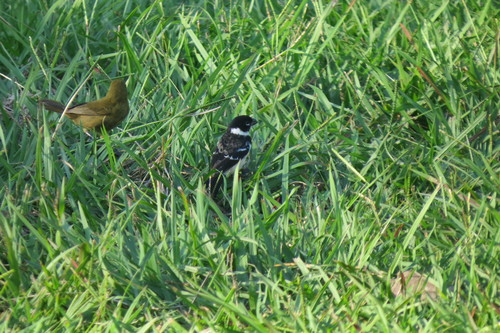
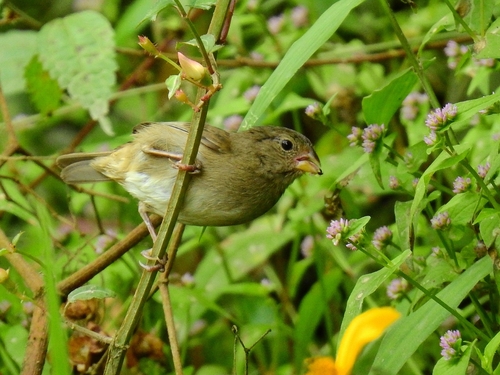
Variable Seedeater vs Morelet's Seedeater
Sporophila corvina versus Sporophila morelleti
Play a quiz with Variable Seedeater and Morelet's Seedeater
Variable Seedeater
Morelet's Seedeater
In short
The Variable Seedeater and Morelet's Seedeater can be distinguished by their male plumage and bill structure. Males of the Variable Seedeater vary geographically but often have more extensive white on the belly and rump, while Morelet's Seedeater males are consistently black-and-white. Both species inhabit similar open habitats, but their ranges overlap only in certain areas.
Identification tips
- Male plumage: Look for geographic variation in Variable Seedeater males; more white in southern populations. Morelet's Seedeater males are consistently black-and-white. 2. Bill structure: Compare bill size and shape if visible; Variable Seedeater may have a slightly stouter bill. 3. Habitat and range: Consider geographic location to help distinguish overlapping areas. 4. Seasonal singing: Listen for Morelet's Seedeater males singing during breeding season.
Size
Both species are small seedeaters with similar size and structure.
Plumage
Male Variable Seedeaters show geographic variation: northern subspecies are all black with a white wing spot, while southern subspecies have more white on the belly and rump. Morelet's Seedeater males are consistently black-and-white. Females and juveniles of both species are similar and more challenging to distinguish.
Behaviour
Both species forage primarily on seeds and are often seen in pairs or small groups. Morelet's Seedeater males are frequently observed singing from March to October.
Habitat
Both species inhabit open areas like pastures, weedy fields, and savannas. Morelet's Seedeater is found from western Panama to Texas, while Variable Seedeater ranges from southeastern Mexico to northwestern South America.
Voice
Vocalizations are not detailed in the sources, but Morelet's Seedeater males are noted for singing prominently during the breeding season.