Birdr

Vaux's Swift vs White-throated Swift

Chaetura vauxi versus Aeronautes saxatalis

Play a quiz with Vaux's Swift and White-throated Swift
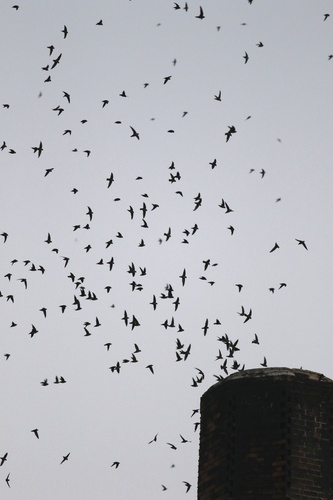
Vaux's Swift (Chaetura vauxi) Vaux's Swift
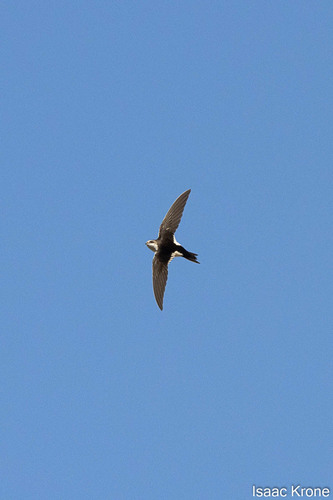
White-throated Swift (Aeronautes saxatalis) White-throated Swift

Media

Loading…

In short

Vaux's Swift and White-throated Swift can be tricky to differentiate in flight, but key differences in plumage and structure can help. Vaux's Swift is generally smaller and more uniformly dark, while White-throated Swift has distinctive white markings on the throat and flanks.

Identification tips

  1. Look for the white throat and flank patches on the White-throated Swift. 2. Note the smaller size and uniform coloration of Vaux's Swift. 3. Consider the habitat: forested areas suggest Vaux's, while open, rocky areas suggest White-throated. 4. Listen for differences in calls, though this can be challenging.

Size

Vaux's Swift is smaller and more compact than the White-throated Swift, which appears longer and more slender in flight.

Plumage

Vaux's Swift is uniformly dark gray-brown, lacking any prominent markings. In contrast, the White-throated Swift has a striking white throat and white patches on the sides of its body, which are visible in flight.

Behaviour

Both species are aerial insectivores, often seen in swift, erratic flight. However, White-throated Swifts may be more likely to be seen flying in open areas or near cliffs.

Habitat

Vaux's Swift is typically found in forested areas, especially near large trees or snags for nesting. White-throated Swift prefers open areas, often near rocky cliffs or canyons.

Voice

Vaux's Swift has a high-pitched, twittering call, while White-throated Swift's call is a more piercing, buzzy note. However, vocalizations can be difficult to distinguish in the field.

Submit a better description

Use the same sections as the comparison. Your text is published immediately.

Vaux's Swift and White-throated Swift can be tricky to differentiate in flight, but key differences in plumage and structure can help. Vaux's Swift is generally smaller and more uniformly dark, while White-throated Swift has distinctive white markings on the throat and flanks.

  1. Look for the white throat and flank patches on the White-throated Swift. 2. Note the smaller size and uniform coloration of Vaux's Swift. 3. Consider the habitat: forested areas suggest Vaux's, while open, rocky areas suggest White-throated. 4. Listen for differences in calls, though this can be challenging.

Vaux's Swift is smaller and more compact than the White-throated Swift, which appears longer and more slender in flight.

Vaux's Swift is uniformly dark gray-brown, lacking any prominent markings. In contrast, the White-throated Swift has a striking white throat and white patches on the sides of its body, which are visible in flight.

Both species are aerial insectivores, often seen in swift, erratic flight. However, White-throated Swifts may be more likely to be seen flying in open areas or near cliffs.

Vaux's Swift is typically found in forested areas, especially near large trees or snags for nesting. White-throated Swift prefers open areas, often near rocky cliffs or canyons.

Vaux's Swift has a high-pitched, twittering call, while White-throated Swift's call is a more piercing, buzzy note. However, vocalizations can be difficult to distinguish in the field.

Discard your changes?

You have unsaved edits. If you leave now, those changes will be lost.

Vaux's Swift · White-throated Swift · My Tricky Birds