Birdr

Velvet Scoter vs Long-tailed Duck

Melanitta fusca versus Clangula hyemalis

Play a quiz with Velvet Scoter and Long-tailed Duck
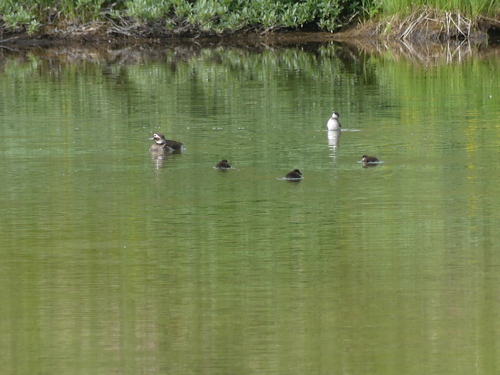
Velvet Scoter (Melanitta fusca) Velvet Scoter
Long-tailed Duck (Clangula hyemalis) Long-tailed Duck

Media

Loading…

In short

The Velvet Scoter and Long-tailed Duck are both sea ducks but differ significantly in appearance and behavior. Velvet Scoters are larger, with a more robust build and predominantly dark plumage, while Long-tailed Ducks are smaller, with striking seasonal plumage changes and distinctive long tail feathers in males.

Identification tips

1. Size and Build: Velvet Scoter is larger and bulkier. 2. Tail Feathers: Look for the long, pointed tail feathers of the male Long-tailed Duck. 3. Wing Patch: Velvet Scoter shows a white wing patch in flight. 4. Bill and Head: In breeding season, male Long-tailed Ducks have a pink band on the bill and a black head. 5. Calls: Listen for the nasal calls of Long-tailed Ducks, especially in wintering areas.

Size

Velvet Scoters are larger and bulkier than Long-tailed Ducks.

Plumage

Velvet Scoters have mostly dark plumage with a white patch on the wings. In contrast, Long-tailed Ducks exhibit seasonal plumage changes: males have elongated central tail feathers and a distinctive pink band on the bill in breeding plumage, with head and body colors shifting between seasons.

Behaviour

Long-tailed Ducks are known for their distinctive, nasal calls and are often seen diving actively. Velvet Scoters are generally quieter and may be observed in larger flocks.

Habitat

Both species inhabit coastal waters, but Velvet Scoters are more likely to be found in large flocks on open seas, while Long-tailed Ducks are often seen in smaller groups closer to shore.

Voice

Long-tailed Ducks have a distinctive, far-carrying nasal call, unlike the relatively quiet Velvet Scoter.

Submit a better description

Use the same sections as the comparison. Your text is published immediately.

The Velvet Scoter and Long-tailed Duck are both sea ducks but differ significantly in appearance and behavior. Velvet Scoters are larger, with a more robust build and predominantly dark plumage, while Long-tailed Ducks are smaller, with striking seasonal plumage changes and distinctive long tail feathers in males.

1. Size and Build: Velvet Scoter is larger and bulkier. 2. Tail Feathers: Look for the long, pointed tail feathers of the male Long-tailed Duck. 3. Wing Patch: Velvet Scoter shows a white wing patch in flight. 4. Bill and Head: In breeding season, male Long-tailed Ducks have a pink band on the bill and a black head. 5. Calls: Listen for the nasal calls of Long-tailed Ducks, especially in wintering areas.

Velvet Scoters are larger and bulkier than Long-tailed Ducks.

Velvet Scoters have mostly dark plumage with a white patch on the wings. In contrast, Long-tailed Ducks exhibit seasonal plumage changes: males have elongated central tail feathers and a distinctive pink band on the bill in breeding plumage, with head and body colors shifting between seasons.

Long-tailed Ducks are known for their distinctive, nasal calls and are often seen diving actively. Velvet Scoters are generally quieter and may be observed in larger flocks.

Both species inhabit coastal waters, but Velvet Scoters are more likely to be found in large flocks on open seas, while Long-tailed Ducks are often seen in smaller groups closer to shore.

Long-tailed Ducks have a distinctive, far-carrying nasal call, unlike the relatively quiet Velvet Scoter.

Discard your changes?

You have unsaved edits. If you leave now, those changes will be lost.

Velvet Scoter · Long-tailed Duck · My Tricky Birds