
Velvet Scoter vs White-winged Scoter
Melanitta fusca versus Melanitta deglandi
Play a quiz with Velvet Scoter and White-winged Scoter
 Velvet Scoter
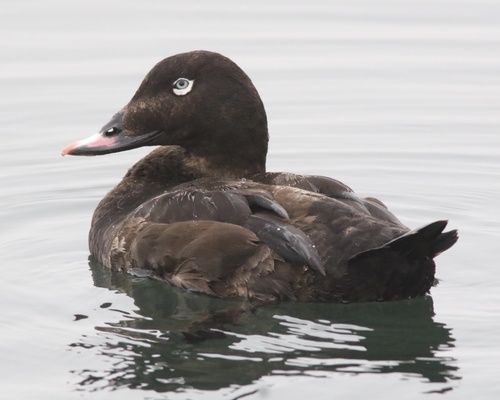 White-winged Scoter
In short
The most reliable field mark between Velvet Scoter and White-winged Scoter is the facial pattern and bill structure, especially in adult males, but age-related variation in females and immatures can cause confusion. Both species show prominent white wing patches in flight, but subtle differences in head shape, bill color, and the extent of white in the face and wing can help with careful observation. Juveniles and females are especially tricky, with variable white facial spots and browner tones, so structural features and bill details become critical. In perched or swimming birds, look closely at the bill shape and facial feathering; in flight, pay attention to the wing patch and overall size and jizz. Both are large, bulky sea ducks, but Velvet Scoter tends to be slightly heavier and has a thicker neck and more pointed tail.
Identification tips
- White wing patch in flight: Both species show prominent white in the wing (speculum) in flight, visible in all ages and sexes. This mark is not diagnostic between the two, but absence of a strong white patch would rule out both.
- Adult male facial pattern: Velvet Scoter males have a small white spot behind the eye; White-winged Scoter males have a more extensive white area around the eye, often forming a crescent. This is a key field mark in adult males.
- Bill color and shape (adult males): Velvet Scoter has a long, broad bill with some orange; White-winged Scoter has an orange-red bill with a large black knob at the base. The knob is less tall than in Stejneger's Scoter but more prominent than in Velvet.
- Female and immature facial pattern: White-winged Scoter females and immatures show variable white spots in front of and behind the eye (especially in young birds), but adult females may lack these and appear all brown. Velvet Scoter females are duller, browner, and lack strong facial white.
- Juvenile upperwing pattern: Juvenile White-winged Scoter males have more extensive white on the greater secondary coverts than juvenile females; Velvet Scoter juveniles are less well described but are expected to show a strong white wing patch in both sexes. Use with caution.
- Body shape and head profile: Velvet Scoter is bulkier, with a thick neck and a more pointed tail. White-winged Scoter is slightly longer-bodied and may appear sleeker in flight.
- Bill feathering at gape (females/immatures): White-winged Scoter has feathering at the base of the upper mandible forming a right angle; Velvet Scoter's bill is less well described but is generally broad and long. This is subtle and best seen at close range.
- Gloss and color of plumage (males): Velvet Scoter males are glossy black; White-winged Scoter males are black but less glossy, with browner flanks in some plumages.
- Tail shape: Velvet Scoter has a more pointed tail, especially noticeable when swimming or in flight.
- Facial pattern in winter: Adult female White-winged Scoters may lack facial white and appear uniformly chocolate-brown, which can overlap with Velvet Scoter females. In these cases, rely more on structure and bill shape.
- Juvenile belly: Juvenile White-winged Scoters have a mottled white belly, which may help in close views; Velvet Scoter juveniles are generally duller and browner.
- Geographic range: If seen in Eurasia, Velvet Scoter is expected; in North America, White-winged Scoter is the default. Vagrants do occur, so do not rely solely on range.
- Group association: Both species often mix with other scoters; check for outliers in flocks for possible vagrants.
- Voice: Not described in the sources, so not reliable for separation here.
- Seasonal variation: Be aware that both species show age and seasonal variation, especially in females and immatures. Use a combination of marks for best accuracy.
Size
Both Velvet Scoter and White-winged Scoter are large sea ducks, but Velvet Scoter is slightly heavier on average (body mass ~1762 g [wikidata]). White-winged Scoter males average 1380 g and females 1180 g, with lengths overlapping (Velvet Scoter 51–56 cm, White-winged Scoter 48–60 cm) [wikipedia, wikidata]. Both have broad wingspans, but Velvet Scoter may appear a bit bulkier and heavier-necked. In the field, size alone is not a strong separator, but Velvet Scoter often looks more robust and thick-necked, while White-winged Scoter can seem slightly longer-bodied and less compact.
Plumage
Juvenile and immature birds are the hardest to separate. Both species show white wing patches (speculum) in flight, but the extent and contrast can vary with age and sex. Juvenile White-winged Scoter males have more extensive white on the greater secondary coverts than juvenile females, but Velvet Scoter of all ages shows a strong white wing patch in both sexes. For perched birds, adult male Velvet Scoter is glossy black with a large white wing patch and a small white spot behind the eye; adult male White-winged Scoter is also black but has a more extensive white area around the eye and a white speculum, with a distinctive orange-red bill and a large black knob at the base. Female and immature White-winged Scoters are brownish, with variable white spots in front of and behind the eye (especially in younger birds), while adult females may lack these patches and appear uniformly chocolate-brown in winter. Velvet Scoter females are duller, browner, and lack the gloss of males, with less prominent facial white. Juvenile White-winged Scoters have more distinct facial patches and a mottled white belly, while Velvet Scoter juveniles are less well described but are generally duller and browner with less facial contrast.
Behaviour
Both species are typically seen swimming in flocks on open water, diving for food. In flight, both are strong and direct, but Velvet Scoter may appear bulkier and heavier-necked, with a more pointed tail. White-winged Scoter can look slightly longer-bodied and sleeker, especially in flight. Both species often associate with other scoters, and behavior alone is rarely diagnostic.
Habitat
Velvet Scoter breeds across northern Europe and western Palearctic, while White-winged Scoter is North American, though vagrants occur. Both favor large lakes, rivers, and coastal waters, especially in winter. Habitat overlap is possible on migration or in wintering flocks, but range is a helpful clue: Velvet Scoter is expected in Eurasia, White-winged Scoter in North America. Both nest near water, often in tundra or woodland edges.