
Violet-backed Starling vs Chestnut-winged Starling
Cinnyricinclus leucogaster versus Onychognathus fulgidus
Play a quiz with Violet-backed Starling and Chestnut-winged Starling
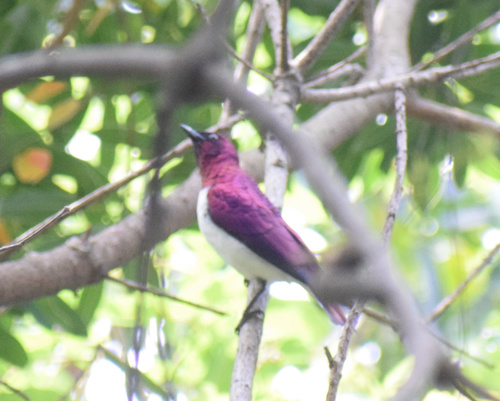 Violet-backed Starling
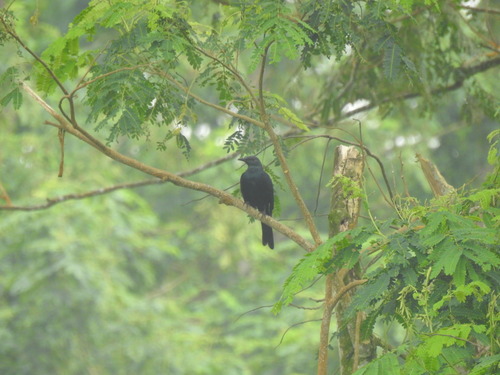 Chestnut-winged Starling
In short
The most reliable field mark to separate Violet-backed Starling from Chestnut-winged Starling is the strong sexual dimorphism and plumage contrast in Violet-backed: adult males are strikingly iridescent violet above with pure white underparts, while females are brown and heavily streaked, resembling a thrush. Chestnut-winged Starling, by contrast, lacks this dimorphism and is characterized by uniformly dark plumage with chestnut-colored wings, without the bold white or streaked underparts. If you see a starling with a bright violet back and clean white belly (male) or a heavily streaked brown-and-white bird (female), it is Violet-backed; a darker bird with chestnut wings in the rainforest is Chestnut-winged. Immature and female Violet-backed Starlings are a common pitfall, as their streaked pattern can be mistaken for other species, but Chestnut-winged never shows this thrush-like streaking.
Identification tips
- Adult male Violet-backed Starling is unmistakable: Look for a small starling with a shimmering violet head and back, and a pure white belly and breast. No other starling in the region shows this combination.
- Adult female Violet-backed Starling is heavily streaked: Females are brown above with bold streaks and white below with heavy streaking, giving a thrush-like appearance. Chestnut-winged Starling never shows this pattern.
- Chestnut-winged Starling has chestnut wings: In all plumages, look for the rich chestnut coloration on the wings, especially visible in flight or good light. The rest of the plumage is dark and lacks strong contrast.
- No white underparts in Chestnut-winged: If you see a starling with clean white underparts (male) or white with heavy streaking (female/immature), it is not Chestnut-winged.
- Sexual dimorphism is key: Only Violet-backed Starling shows strong differences between male and female; Chestnut-winged is similar in both sexes.
- Iridescence is diagnostic for Violet-backed males: The violet gloss is unique and not matched by the more matte, dark plumage of Chestnut-winged.
- Juvenile/immature confusion: Young Violet-backed Starlings resemble adult females and can be mistaken for other streaked birds, but Chestnut-winged juveniles are not streaked.
- Habitat context: In dense rainforest, Chestnut-winged is more likely; at woodland or forest edge, expect Violet-backed.
- Feeding height: Violet-backed is often high in the canopy, rarely on the ground, which may help if you see a starling foraging low.
- Bill, legs, and iris: Both species have dark bills and legs, but Violet-backed has yellow irises in both sexes, which may be visible at close range.
- Perched vs. flight views: In flight, look for chestnut in the wings (Chestnut-winged) versus violet gloss or streaked brown (Violet-backed). Perched, the white underparts or heavy streaking of Violet-backed are obvious.
- No strong size difference: Do not rely on size to separate these two.
- No voice differences described: Vocalizations are not a reliable separator based on current notes.
- Pitfall: Female and immature Violet-backed Starlings are often misidentified as other streaked birds; always check for the combination of streaked underparts and habitat.
- Contextual clues: Consider the surrounding habitat and flock composition, as Violet-backed may join mixed flocks in open woodland, while Chestnut-winged is more restricted to rainforest.
Size
Violet-backed Starling is a relatively small starling, measuring about 17–18 cm in length [wikipedia]. Chestnut-winged Starling's precise measurements are not given in the notes, but both are medium-small starlings and likely overlap in size. Size alone is not a reliable separator in the field between these two species.
Plumage
- Adult males (Violet-backed Starling): Iridescent violet head and back, pure white underparts. This bold contrast is unique among starlings in the region. Chestnut-winged Starling males do not show this coloration; instead, they are dark overall with chestnut-colored wings, lacking any white underparts or violet gloss.
- Adult females (Violet-backed Starling): Brown upperparts with bold streaks and white, heavily streaked underparts, giving a thrush-like look. Chestnut-winged Starling females do not have this streaked pattern; their plumage is more uniform and dark, with the only contrast being the chestnut wings.
- Immature/juvenile Violet-backed Starling: Not explicitly described, but likely similar to adult female with streaked appearance. Chestnut-winged Starling juveniles are not detailed, but no evidence suggests they show strong streaking or white underparts.
- Wing pattern in flight: No specific notes for either species, but the chestnut coloration in Chestnut-winged is likely visible in flight, while Violet-backed shows either violet gloss (male) or streaked brown (female/immature) without chestnut tones.
Behaviour
Violet-backed Starling tends to feed high in the canopy, rarely coming to the ground, and may sally out for insects like a flycatcher [wikipedia]. Chestnut-winged Starling's foraging behavior is not described in detail, but it is generally typical of starlings. Both nest in tree cavities or crevices, but this is not a field mark. Behavior is not a strong separator, though Violet-backed's canopy preference may be a subtle clue.
Habitat
Violet-backed Starling is found at woodland and savannah forest edges across sub-Saharan Africa [wikipedia]. Chestnut-winged Starling is a species of the African tropical rainforest [wikipedia]. Thus, Violet-backed is more likely at drier, open woodland edges, while Chestnut-winged is expected in humid, dense rainforest. Overlap is possible at forest margins, but habitat can be a useful supporting clue.
Violet-backed Starling · Chestnut-winged Starling · My Tricky Birds