
Violet-backed Starling vs Somali Starling
Cinnyricinclus leucogaster versus Onychognathus blythii
Play a quiz with Violet-backed Starling and Somali Starling
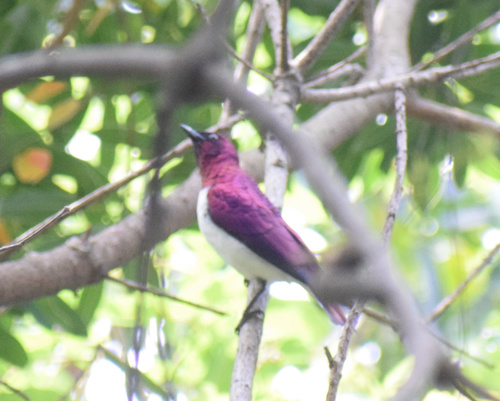 Violet-backed Starling
 Somali Starling
In short
The most reliable field mark is the strong sexual dimorphism of Violet-backed Starling: adult males are strikingly iridescent violet above and pure white below, while females are brown and heavily streaked, resembling a thrush. Somali Starling, by contrast, lacks this dimorphism and is overall much larger and heavier-bodied. If you see a small, thrush-like starling with bold streaking, it is Violet-backed Starling (female or immature); a much bulkier, uniform starling in the Horn of Africa is Somali Starling. Immature and female Violet-backed Starlings are a common pitfall due to their cryptic, streaked appearance, but size and structure are key clues.
Identification tips
- Sexual dimorphism: Only Violet-backed Starling is strongly sexually dimorphic. Adult males are bright iridescent violet above and pure white below; females are brown with heavy streaking. Somali Starling shows no such contrast between sexes.
- Female/immature confusion: Female and immature Violet-backed Starlings are brown above and heavily streaked below, resembling a thrush. Somali Starling is not streaked and appears more uniform.
- Size: Somali Starling is much heavier and bulkier (about 100 g) than the delicate Violet-backed Starling (about 17–18 cm and much lighter). If the bird looks large and heavy for a starling, Somali is more likely.
- Bill and structure: Violet-backed Starling is small and fine-billed, with a delicate appearance. Somali Starling is robust and heavy-billed.
- Iridescence: Only adult male Violet-backed Starling shows strong violet iridescence. Somali Starling lacks this and is more subdued.
- Underparts: Violet-backed Starling males have pure white underparts; females and immatures have white with heavy streaking. Somali Starling does not show this contrast.
- Habitat: Violet-backed Starling is found in woodlands and forest edges; Somali Starling is restricted to the Horn of Africa and may be found in more arid or open habitats.
- Geographic range: If you are outside Djibouti, Eritrea, Ethiopia, Somalia, or Socotra, Somali Starling is not present.
- Behavior: If observed flycatching or foraging high in the canopy, suspect Violet-backed Starling. Somali Starling is likely less agile and less arboreal.
- Eye color: Both have yellow irises, so this is not a useful separator.
- Leg and bill color: Both have black bills and legs; not diagnostic.
- Ground foraging: Violet-backed Starling rarely forages on the ground; Somali Starling's habits are less clear but likely more terrestrial due to its size.
- Nest location: Violet-backed Starling nests in tree crevices a few meters above ground; not a field mark but may help in context.
- Juvenile/immature wing pattern: No distinctive flight marks are described for either species, so rely on overall plumage and structure for young birds.
- Pitfall: The main confusion arises with female/immature Violet-backed Starling, which can look like a small thrush; check for size, structure, and streaking to avoid misidentification.
Size
Violet-backed Starling is a small starling, about 17–18 cm in length, and is noticeably lighter and more delicate than Somali Starling. Somali Starling is much heavier, with an adult mass around 100 g [wikidata], making it robust and noticeably bulkier in the field. This size difference is often apparent even at a distance, especially when both species are seen in the same region (though their ranges overlap little).
Plumage
Adult male Violet-backed Starlings are unmistakable with their iridescent violet head and back and pure white underparts. Females and immatures are brown above with bold, thrush-like streaking on both upperparts and underparts. Somali Starling, by contrast, does not show this strong sexual dimorphism or bold streaking; its plumage is more uniform and lacks the crisp contrast of Violet-backed Starling females/immatures. Both sexes of Somali Starling appear similar and are generally plain compared to the highly patterned Violet-backed Starling females/immatures. No distinctive juvenile or immature wing pattern is described for either species in the sources, so focus on overall plumage and structure.
Behaviour
Violet-backed Starling typically forages high in the canopy, rarely coming to the ground, and sometimes hawks insects in flight like a flycatcher. Somali Starling's foraging behavior is not detailed in the sources, but its larger size and heavier build suggest it is less likely to perform agile aerial maneuvers or feed high in the canopy. If you observe a starling actively flycatching or staying high in trees, Violet-backed is more likely.
Habitat
Violet-backed Starling is found widely in sub-Saharan Africa, especially in woodlands and at the edges of savannah forests. Somali Starling is restricted to the Horn of Africa (Djibouti, Eritrea, Ethiopia, Somalia, and Socotra) and is not found in the broader sub-Saharan range. If you are outside the Horn of Africa, Somali Starling can be ruled out. Within the Horn, check for habitat: Violet-backed prefers wooded areas, while Somali Starling may occur in more arid or open habitats.