
Birdr

Wandering Whistling-Duck vs Lesser Whistling-Duck

Dendrocygna arcuata versus Dendrocygna javanica

Play a quiz with Wandering Whistling-Duck and Lesser Whistling-Duck
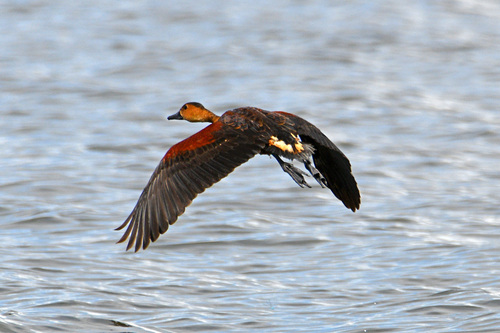
Wandering Whistling-Duck (Dendrocygna arcuata) Wandering Whistling-Duck
Lesser Whistling-Duck (Dendrocygna javanica) Lesser Whistling-Duck

Media

Loading…

In short

The Wandering Whistling-Duck and Lesser Whistling-Duck are both medium-sized ducks with similar whistling calls, but they can be distinguished by their structure and plumage. The Wandering Whistling-Duck has a longer neck and legs, giving it a more upright posture compared to the more compact Lesser Whistling-Duck.

Identification tips

Look for the longer neck and legs of the Wandering Whistling-Duck, giving it a more upright posture. Observe the plumage contrast: the Lesser Whistling-Duck often has a paler face and throat. Consider the habitat: Wandering Whistling-Ducks are more likely in open water, while Lesser Whistling-Ducks prefer vegetated wetlands.

Size

The Wandering Whistling-Duck is slightly larger with a longer neck and legs, while the Lesser Whistling-Duck is more compact.

Plumage

Both species have brown plumage, but the Wandering Whistling-Duck has a more uniform dark brown body with less contrast between the head and body. The Lesser Whistling-Duck often shows a more distinct contrast with a paler face and throat.

Behaviour

Both species are social and often found in flocks, but the Wandering Whistling-Duck may be seen more often in open water compared to the Lesser Whistling-Duck, which prefers vegetated wetlands.

Habitat

The Wandering Whistling-Duck is typically found in larger bodies of water such as lakes and lagoons, while the Lesser Whistling-Duck is more common in marshes and rice paddies.

Voice

Both species produce similar whistling calls, making vocalizations not a reliable distinguishing feature.

Submit a better description

Use the same sections as the comparison. Your text is published immediately.

The Wandering Whistling-Duck and Lesser Whistling-Duck are both medium-sized ducks with similar whistling calls, but they can be distinguished by their structure and plumage. The Wandering Whistling-Duck has a longer neck and legs, giving it a more upright posture compared to the more compact Lesser Whistling-Duck.

Look for the longer neck and legs of the Wandering Whistling-Duck, giving it a more upright posture. Observe the plumage contrast: the Lesser Whistling-Duck often has a paler face and throat. Consider the habitat: Wandering Whistling-Ducks are more likely in open water, while Lesser Whistling-Ducks prefer vegetated wetlands.

The Wandering Whistling-Duck is slightly larger with a longer neck and legs, while the Lesser Whistling-Duck is more compact.

Both species have brown plumage, but the Wandering Whistling-Duck has a more uniform dark brown body with less contrast between the head and body. The Lesser Whistling-Duck often shows a more distinct contrast with a paler face and throat.

Both species are social and often found in flocks, but the Wandering Whistling-Duck may be seen more often in open water compared to the Lesser Whistling-Duck, which prefers vegetated wetlands.

The Wandering Whistling-Duck is typically found in larger bodies of water such as lakes and lagoons, while the Lesser Whistling-Duck is more common in marshes and rice paddies.

Both species produce similar whistling calls, making vocalizations not a reliable distinguishing feature.

Discard your changes?

You have unsaved edits. If you leave now, those changes will be lost.

Wandering Whistling-Duck · Lesser Whistling-Duck · My Tricky Birds