
Water Pipit vs Rock Pipit
Anthus spinoletta versus Anthus petrosus
Play a quiz with Water Pipit and Rock Pipit
 Water Pipit
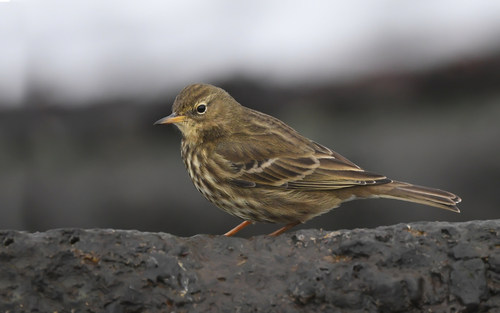 Rock Pipit
In short
The most reliable field mark to separate Water Pipit from Rock Pipit is the color of the outer tail feathers: Water Pipit shows clean white outer tail feathers (all ages), while Rock Pipit’s are dusky or buff. In breeding plumage, Water Pipit is paler below with a strong white supercilium and less streaking, while Rock Pipit is dingier, more heavily streaked, and lacks a clear supercilium. Immature birds of both species can look similar, but Water Pipit juveniles are paler and more streaked below, with a whiter tail edge. Habitat is also a strong clue: Water Pipit breeds in upland or alpine meadows, Rock Pipit on rocky coasts. Structure and size overlap, but Water Pipit tends to look longer-tailed and more upright.
Identification tips
- Tail pattern in flight (all ages): Water Pipit shows white outer tail feathers; Rock Pipit’s are dusky or buff. This is the most reliable mark in all seasons and ages.
- Supercilium (breeding/adult): Water Pipit has a strong white supercilium, especially in breeding plumage; Rock Pipit’s is faint or absent except in some littoralis birds, which may show a pale eyebrow but never as bold as Water Pipit.
- Underparts color (breeding/adult): Water Pipit is pale below with a pink-buff wash on the breast, fading to whitish belly; Rock Pipit is buff below, heavily streaked, and never as clean or pale.
- Streaking (all ages): Water Pipit is less streaked on breast and flanks (breeding), with streaks often faint or limited; Rock Pipit is more heavily and diffusely streaked below, especially on the flanks.
- Upperparts (all ages): Water Pipit is greyer above, especially on the head; Rock Pipit is browner or smoky-olive, with less contrast between head and back.
- Leg color: Both have dark legs, so this is not helpful.
- Bill and iris: Both are dark, not a separator.
- Juvenile/immature plumage: Water Pipit juveniles are paler and more streaked below, with whiter tail edges; Rock Pipit juveniles are browner, more heavily streaked above, and have dusky outer tail feathers.
- Structure: Water Pipit often appears longer-tailed and more upright, especially when alert; Rock Pipit is stockier and more horizontal.
- Behavior: Water Pipit is warier and flushes at greater distance; Rock Pipit is more confiding on rocks.
- Habitat: Water Pipit is found in upland meadows, wet lowlands, or muddy margins; Rock Pipit is strictly coastal on rocks and seaweed.
- Subspecies confusion: Littoralis Rock Pipit in summer can show a pale supercilium and pinkish underparts, resembling Water Pipit, but tail pattern (dusky vs white) and habitat remain reliable.
- Sex differences: Both species are similar between sexes; Water Pipit females may have a greyer head, but this is subtle and not diagnostic in the field.
- Seasonal changes: Water Pipit is paler in breeding season, duller and more streaked in winter; Rock Pipit is always darker and more streaked, with less seasonal change.
- Vocalizations: Calls are subtly different; Rock Pipit’s 'pseep' is shriller, Water Pipit’s 'fist' is thinner and higher-pitched, but these are best used as supporting marks.
Size
Water Pipit is 15–17 cm long and weighs 18.7–23 g, while Rock Pipit is slightly larger at 16.5–17 cm and 18–32.5 g. In the field, both appear similar in length, but Rock Pipit can look bulkier, especially in the hand or at close range. However, size is not a reliable field mark due to overlap and posture differences.
Plumage
- Juvenile/immature birds: Both species' juveniles resemble dull, streaky pipits, but Water Pipit juveniles are paler above and below, with more prominent streaking on the underparts and a whiter edge to the tail. Rock Pipit juveniles are browner, more heavily streaked above, and have dusky outer tail feathers.
- Adult breeding plumage: Water Pipit is pale below with a pink-buff wash on the breast and a strong white supercilium; upperparts are greyish-brown with weak streaking. Rock Pipit is dingier, with smoky-olive upperparts, buff underparts heavily streaked with brown, and lacks a strong supercilium. The head of Water Pipit is greyer, especially in females.
- Non-breeding plumage: Water Pipit becomes greyer-brown above, supercilium less distinct, underparts whiter with light brown streaks on breast/flanks. Rock Pipit remains darker, with more diffuse streaking and a less contrasting face. Littoralis Rock Pipit can show a pale supercilium and pinkish underparts in summer, but outer tail feathers remain dusky, not white.
- Tail: Water Pipit always has white outer tail feathers (sometimes with a hint of grey in some subspecies), while Rock Pipit’s are dusky or buff. This is visible in flight and often when perched.
Behaviour
Both species are terrestrial and walk with a similar gait, but Water Pipit often appears more upright and is typically warier, flushing at greater distance. Rock Pipit is highly territorial on rocky coasts and may allow closer approach. In display, Rock Pipit males perform parachuting song flights over territory; Water Pipit’s display is less conspicuous. Both species feed on the ground, but Water Pipit is more likely to be seen in open, grassy, or muddy areas, while Rock Pipit sticks to rocks and seaweed.
Habitat
Habitat is a strong separator: Water Pipit breeds in upland or alpine meadows and winters in wet lowlands, marshes, or river valleys, rarely near the sea. Rock Pipit is strictly coastal, breeding and wintering on rocky shores, jetties, and seaweed-covered beaches. Even in winter, overlap is minimal. If seen inland, Water Pipit is vastly more likely.
Voice
Rock Pipit’s song is a tinkling sequence of cheepa notes, rising gee calls, and a short trill, while Water Pipit’s song is different (not detailed here). Rock Pipit’s flight call is a shrill 'pseep', intermediate between Meadow and Water Pipit. Water Pipit’s call is a short, thin 'fist.' Calls are subtle and not always diagnostic, but Water Pipit’s is higher-pitched and thinner.