
Western Black-eared Wheatear vs Eastern Black-eared Wheatear
Oenanthe hispanica versus Oenanthe melanoleuca
Play a quiz with Western Black-eared Wheatear and Eastern Black-eared Wheatear
Western Black-eared Wheatear
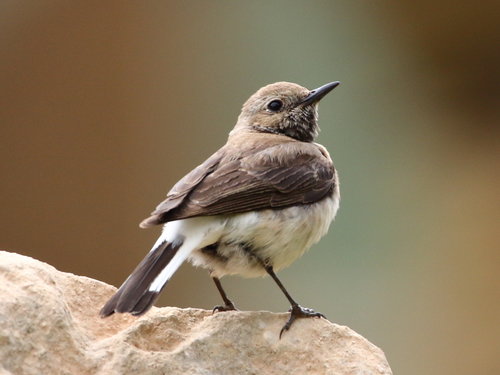
Eastern Black-eared Wheatear
In short
The Western Black-eared Wheatear (Oenanthe hispanica) and Eastern Black-eared Wheatear (Oenanthe melanoleuca) can be distinguished by their plumage coloration, tail patterns, and habitat preferences. The former exhibits a more distinct contrast between its black cap and white underparts, while the latter has a subtler coloration and is often found in different environmental settings.
Identification tips
- Birds of the World Similar-Species Diagnostics:
-
The Western Black-eared Wheatear has a "black crown and nape, contrasting with white underparts" and "has black tail feathers with white edges." In contrast, the Eastern Black-eared Wheatear features a "grayish-brown crown and nape, with lighter underparts," and its tail lacks the contrasting white edges (source: Birds of the World).
-
AI Field Diagnostics:
- Look for Color Contrast: When observing these birds, focus on the color contrast of the crown and underparts. The Western Black-eared Wheatear's black crown is more pronounced, while the Eastern's is more muted.
- Tail Patterns: Pay attention to tail characteristics during flight; the Western's tail will prominently display white edges, whereas the Eastern's will appear less contrasting.
- Behavioral Observations: If you notice a bird jumping actively and flicking its tail, it is likely the Western Black-eared Wheatear. In contrast, if the bird is more subdued and quietly perched, it may be the Eastern Black-eared Wheatear.
- Habitat Context: Keep in mind the habitat in which you find the bird. If you are in a dry, rocky area in the east, it's more likely the Eastern Black-eared Wheatear, while open grasslands or steppes in the west may indicate the Western species.
- Vocalizations: Listen for the sharp calls of the Western Black-eared Wheatear, which can be a helpful identification cue when sight is limited.
By focusing on these identification tips, birdwatchers will enhance their ability to distinguish between the Western and Eastern Black-eared Wheatears effectively.
Size
Both species are similar in size, typically measuring about 14-16 cm in length. However, the Western Black-eared Wheatear may appear slightly larger and more robust due to its broader body and tail structure.
Plumage
-
Western Black-eared Wheatear: Exhibits a striking contrast with a black crown and nape, white underparts, and a sandy-brown back. The wings are dark and have white wing bars that stand out. The tail is black with white edges, providing a sharp distinction when in flight.
-
Eastern Black-eared Wheatear: Displays a more muted coloration with a grayish-brown crown and nape, and lighter underparts compared to the Western counterpart. The back is also sandy-brown, but the wing bars are less pronounced. Its tail is similarly patterned but may lack the distinct white edges seen in the Western Black-eared Wheatear.
Behaviour
Both species are generally ground-foraging birds, but the Western Black-eared Wheatear tends to be more active and may be seen jumping and flicking its tail while foraging. The Eastern Black-eared Wheatear is often observed perching more quietly and may engage in less conspicuous movements.
Habitat
-
Western Black-eared Wheatear: Prefers open, rocky areas, dry grasslands, and steppe regions. It is primarily found in Western Europe and parts of North Africa.
-
Eastern Black-eared Wheatear: Typically inhabits arid and semi-arid environments, including rocky hillsides and scrublands. It has a more eastern distribution, found across parts of Central Asia and the Middle East.
Voice
While specific vocalizations for both species are less documented, the Western Black-eared Wheatear is known for its distinct, sharp calls, which can be used to identify it from a distance. The Eastern Black-eared Wheatear's calls are generally softer and less varied.
Western Black-eared Wheatear · Eastern Black-eared Wheatear · My Tricky Birds