
Western Black-eared Wheatear vs Pied Wheatear
Oenanthe hispanica versus Oenanthe pleschanka
Play a quiz with Western Black-eared Wheatear and Pied Wheatear
Western Black-eared Wheatear
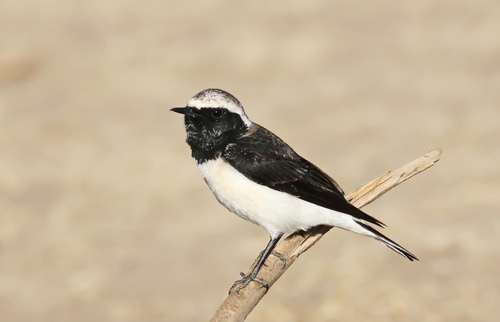
Pied Wheatear
In short
The Western Black-eared Wheatear and Pied Wheatear are similar in structure but can be distinguished by plumage details and habitat preferences. The Western Black-eared Wheatear typically has a more pronounced black mask and ear coverts, while the Pied Wheatear often shows a more extensive black throat patch.
Identification tips
- Look for the black mask: Western Black-eared Wheatear has a more pronounced black mask through the ear coverts.
- Check the throat patch: Pied Wheatear often has a more extensive black throat.
- Observe the habitat: Western Black-eared Wheatear favors arid, open areas, while Pied Wheatear may be in slightly more vegetated regions.
- Consider the season: Plumage differences are most noticeable in breeding males; females and non-breeding individuals can be more challenging to differentiate.
Size
Both species are similar in size, typical of small wheatears.
Plumage
The Western Black-eared Wheatear usually has a black mask extending through the ear coverts, whereas the Pied Wheatear often has a more extensive black throat. In males, the Western Black-eared Wheatear may show a paler back and more contrasting black and white patterning, while the Pied Wheatear tends to have a more uniform appearance.
Behaviour
Both species exhibit typical wheatear behavior, such as perching on rocks and making short flights to catch insects.
Habitat
The Western Black-eared Wheatear is often found in more arid, open habitats, while the Pied Wheatear prefers slightly more vegetated areas, though there is overlap.
Voice
Vocalizations are similar and not a reliable distinguishing feature in the field.
Western Black-eared Wheatear · Pied Wheatear · My Tricky Birds