
Western Cattle-Egret vs Great White Egret
Ardea ibis versus Ardea alba
Play a quiz with Western Cattle-Egret and Great White Egret
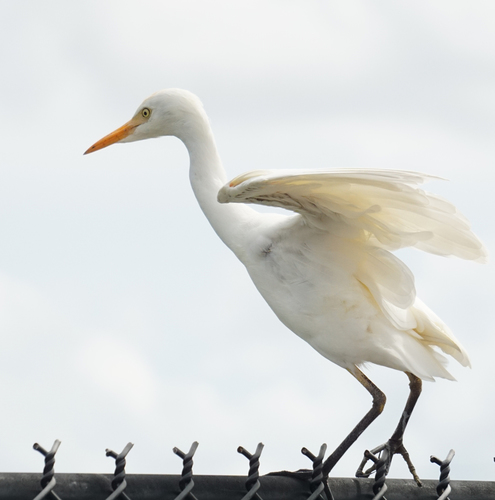 Western Cattle-Egret
 Great White Egret
In short
The most reliable way to separate Western Cattle-Egret from Great White Egret is by size and structure: Cattle-Egret is much smaller and stockier, with a short, thick neck and a sturdy, relatively short bill, while Great White Egret is tall and elegant, with a long neck and slender bill. Both are all-white in non-breeding plumage, but Cattle-Egret often shows orange-buff plumes in breeding season, and has yellowish to greyish-yellow legs (not black). In flight or at rest, Great White Egret’s sheer size, long neck, and black legs stand out. Juvenile and non-breeding birds of both species are all-white, so structure and leg color are crucial. Watch for context: Cattle-Egret often forages terrestrially, especially near livestock, while Great White Egret is more strictly aquatic.
Identification tips
- Size is the fastest field clue: Great White Egret is nearly twice the length and several times the mass of Cattle-Egret. If a white heron looks only slightly larger than a crow or pigeon, it's a Cattle-Egret; if it's as tall as a Grey Heron, it's a Great White Egret.
- Structure and posture: Cattle-Egret is compact, with a short, thick neck and a sturdy, relatively short bill. Great White Egret is tall, with a long, slender neck and a long, pointed bill. In flight, Cattle-Egret looks stubby and hunched; Great White Egret is elongated and graceful.
- Leg color: Cattle-Egret has yellowish or greyish-yellow legs (never black). Great White Egret has black legs and feet, though the lower legs may look paler in breeding season. This is a key mark when birds are standing or wading.
- Bill color (by age): Adult Cattle-Egret has a yellow bill, but juveniles have a black bill. Great White Egret (all ages) has a yellow bill, sometimes darkening at the base in breeding season. If you see a small white egret with a black bill, it's a juvenile Cattle-Egret, not a Great White Egret.
- Breeding plumage: In breeding season, Cattle-Egret shows orange-buff plumes on the head, breast, and back, and may briefly have a red bill and legs. Great White Egret develops delicate white ornamental plumes on the back, but never shows orange or buff tones.
- Neck length: Even when hunched, Great White Egret's neck is proportionally much longer than Cattle-Egret's. In flight, Great White Egret's neck forms a large S-curve, while Cattle-Egret's neck is short and barely projects beyond the body.
- Foraging behavior: Cattle-Egret is often seen in dry fields, especially near livestock, walking among grass or even riding on cattle. Great White Egret is almost always seen in or near water, stalking prey in wetlands.
- Habitat context: If the bird is far from water, especially in a pasture, it's likely a Cattle-Egret. If it's in a marsh, lake, or river, especially alone or with other large herons, suspect Great White Egret.
- Flight jizz: Cattle-Egret appears compact, with broad wings and a short neck tucked in. Great White Egret is long-winged, with a trailing black leg line and a long neck retracted into a deep S.
- Plumage pitfalls: Both species are all-white in non-breeding and juvenile plumage, so don't rely on color alone outside the breeding season. Use structure, size, and leg color.
- Voice: Not usually helpful unless at a colony, but Cattle-Egret's call is quieter and more throaty, while Great White Egret's is a loud croak or squawk.
- Sex and age: Both species show little sexual dimorphism; males and females look alike. Juveniles of both are all-white, but Cattle-Egret juveniles have a black bill, while Great White Egret juveniles have a yellow bill.
- Associations: Cattle-Egret is often in flocks, sometimes mixed with livestock or other birds, while Great White Egret is more solitary or in loose groups with other large herons.
- When in doubt: If you can't judge size, focus on leg color and bill structure. If the legs are black, it's a Great White Egret. If the bird is small, stocky, and has yellowish legs, it's a Cattle-Egret.
- Common pitfalls: Don't confuse a distant Great White Egret for a Cattle-Egret based on posture alone—always try to get a sense of scale and check leg color.
Size
Great White Egret is dramatically larger: it stands up to 1 meter tall, measures 80–104 cm in length, and has a wingspan of 131–170 cm, with an average mass around 1,000 g. Western Cattle-Egret is much smaller and stockier, only 46–56 cm long, with a wingspan of 88–96 cm and a mass of 270–512 g. In the field, this size difference is usually obvious, especially when both species are seen together or near familiar birds for scale.
Plumage
Juvenile and non-breeding Western Cattle-Egrets and Great White Egrets are both all-white, lacking any distinctive upperwing or flight pattern marks—so age-specific wing pattern is not helpful for separation. In breeding season, adult Cattle-Egrets develop orange-buff plumes on the back, breast, and crown, and their bill, legs, and irises may briefly become bright red. Great White Egret adults in breeding plumage show delicate ornamental plumes on the back but remain all-white, with the bill sometimes darkening and the lower legs becoming paler. Leg color is a key difference: Cattle-Egret has yellowish or greyish-yellow legs (never black), while Great White Egret has black legs and feet year-round (though the lower legs may lighten a bit in breeding season). Juveniles of both species are all-white, but Cattle-Egret juveniles have a black bill, while Great White Egret juveniles look like non-breeding adults with a yellow bill.
Behaviour
Western Cattle-Egret is adapted to foraging on land, often seen walking in fields, especially near grazing livestock, and has a hunched, compact posture. Great White Egret is more aquatic, usually found wading in wetlands, lakes, and rivers, with a graceful, upright stance and a slow, deliberate walk. In flight, both species retract their necks, but Great White Egret appears longer-winged and more elegant, while Cattle-Egret looks compact and short-necked.
Habitat
Cattle-Egret is most often found in open fields, grasslands, and agricultural areas, frequently associating with cattle or other large mammals. It is less tied to water than most herons and egrets. Great White Egret prefers wetlands, lakes, rivers, and marshes, rarely straying far from water. While their ranges overlap, their preferred habitats and foraging strategies are usually distinct, with Cattle-Egret terrestrial and Great White Egret aquatic.
Voice
Both species are mostly silent away from colonies. Cattle-Egret gives a quiet, throaty 'rick-rack' call at breeding sites, while Great White Egret produces a low, hoarse croak or a loud 'cuk cuk cuk' at colonies and higher-pitched squawks when disturbed. Vocalizations are rarely diagnostic in the field unless at a nesting colony.