Birdr

Western House Martin vs Asian House Martin

Delichon urbicum versus Delichon dasypus

Play a quiz with Western House Martin and Asian House Martin

Western House Martin (Delichon urbicum) Western House Martin
Asian House Martin (Delichon dasypus) Asian House Martin

Media

Loading…

In short

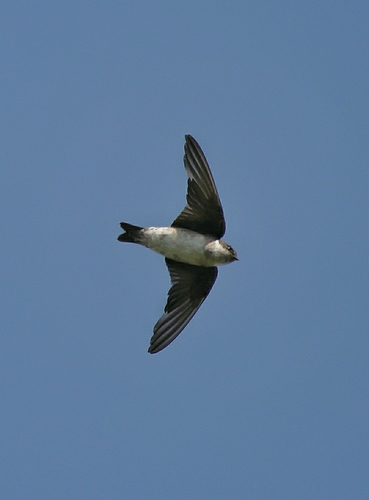
The most reliable field mark between Western House Martin and Asian House Martin is the color and contrast of the underparts: Western House Martin shows clean, bright white underparts and underwings, while Asian House Martin has pale grey or grey-washed underparts and greyer underwings, making it look dingier below in almost all lights. Both species have a white rump and blue-black upperparts, but the Western House Martin is whiter below and often appears cleaner and more sharply marked in flight. Juveniles of both species are duller, but Western House Martin juveniles are sooty black above with white-tipped wing coverts, while Asian House Martin juveniles are brownish above with grey-white underparts. Tail shape is another subtle difference: Western House Martin has a more deeply forked tail, especially in the nominate form, while Asian House Martin's tail fork is shallower. These distinctions are most visible in good light and when birds are seen from below or in side profile.

Identification tips

  1. Underparts color: Western House Martin always shows clean, bright white underparts and underwings (all ages), while Asian House Martin is pale grey or grey-washed below, with grey-brown underwings. This is the most reliable field mark in all conditions.
  2. Rump color: Both have a white rump, but in Asian House Martin, the contrast with the darker upperparts may be less sharp, especially in some subspecies. Western House Martin's rump is always bright white and stands out clearly.
  3. Tail fork: Western House Martin has a more deeply forked tail (especially in the nominate urbicum), while Asian House Martin's tail is only slightly forked. This is best seen in flight or when perched with the tail spread.
  4. Juvenile upperparts: Juvenile Western House Martins are sooty black above with white-tipped wing coverts and quills; Asian House Martin juveniles are dark brown above, sometimes with a brownish rump, and lack the crisp white tips.
  5. Juvenile underparts: Juvenile Western House Martin is white below, while Asian House Martin is grey-white or dingier.
  6. Adult upperparts: Both are steel-blue or blue-black above, but Asian House Martin may appear slightly darker and less glossy, especially in worn plumage.
  7. Legs and feet: Both species have feathered legs, but this is rarely visible in the field and not a practical separator.
  8. Bill and eye color: Both have small black bills and brown eyes; not useful for separation.
  9. Sex differences: Both species are sexually similar, but male Asian House Martins may be slightly whiter below than females, though still never as white as Western House Martin.
  10. Subspecies confusion: The eastern subspecies of Western House Martin (lagopodum) has a less forked tail, approaching Asian House Martin, but still usually shows a more pronounced fork.
  11. Flight style: Both are agile and buoyant; Western House Martin may show a slightly faster wingbeat, but this is not a reliable field mark.
  12. Habitat: Western House Martin is more likely in urban or lowland settings, Asian House Martin in mountains or cliffs, but both can nest on buildings.
  13. Voice: Calls are similar; Asian House Martin's is slightly more rasping, but this is subtle and not a primary separator.
  14. Pitfalls: Do not rely on size, as both are nearly identical. Lighting can make Asian House Martin look paler or Western House Martin dingier, so always check multiple features.
  15. Best views: Aim for a side or below view in good light to assess underpart color and tail fork; beware of juveniles, which are duller but still show the same underpart contrast.

Size

Both species are very similar in size, with Western House Martin averaging about 13 cm in length and Asian House Martin about 12 cm. Their body masses are nearly identical (Western House Martin: ~18.3 g, Asian House Martin: 18.0 g) [wikipedia][wikidata]. In the field, size is not a reliable separator, as both appear equally small and compact for a swallow.

Plumage

Juvenile and immature birds are most easily separated by the color and contrast of the underparts and upperparts. Juvenile Western House Martins are sooty black above with white-tipped wing coverts and quills, and have white underparts. Juvenile Asian House Martins are less glossy, with dark brown upperparts (sometimes with a brownish wash to the rump) and grey-white underparts. In adults, Western House Martin is steel-blue above with a bright white rump and pure white underparts and underwings; Asian House Martin is dark steel-blue above with a white rump, but the underparts are always pale grey or grey-washed, never pure white, and the underwings are grey-brown. The tail of Western House Martin is more deeply forked, while Asian House Martin's tail is only slightly forked. The legs of both are feathered white, but this is rarely visible in the field.

Behaviour

Both species are aerial insectivores, feeding on the wing and often foraging high above ground. Both breed colonially and build mud nests under overhangs or on buildings. Flight style is similar, but Western House Martin is noted to have a slightly faster wingbeat (5.3 beats/sec vs. 4.4 for Barn Swallow) [wikipedia], though this is not compared directly to Asian House Martin. Both species are agile and buoyant in flight, and differences in jizz are subtle and not reliable for field separation.

Habitat

Western House Martin breeds across Europe, North Africa, and west-central Asia, often near human habitation and open country. Asian House Martin breeds in the Himalayas and central/eastern Asia, favoring mountain cliffs and sometimes buildings for nesting. In areas of overlap (central Asia), habitat can be similar, but Asian House Martin is more likely in montane or cliff habitats, while Western House Martin is more urban or lowland. However, both can nest on buildings, so habitat alone is not diagnostic.

Voice

Both species have similar calls: a metallic trill or twitter and a dry, metallic 'cheep.' Asian House Martin's call is described as more rasping than Western House Martin's, but this difference is subtle and not likely to be diagnostic in the field unless you are very familiar with both species' vocalizations.

Submit a better description

Use the same sections as the comparison. Your text is published immediately.

The most reliable field mark between Western House Martin and Asian House Martin is the color and contrast of the underparts: Western House Martin shows clean, bright white underparts and underwings, while Asian House Martin has pale grey or grey-washed underparts and greyer underwings, making it look dingier below in almost all lights. Both species have a white rump and blue-black upperparts, but the Western House Martin is whiter below and often appears cleaner and more sharply marked in flight. Juveniles of both species are duller, but Western House Martin juveniles are sooty black above with white-tipped wing coverts, while Asian House Martin juveniles are brownish above with grey-white underparts. Tail shape is another subtle difference: Western House Martin has a more deeply forked tail, especially in the nominate form, while Asian House Martin's tail fork is shallower. These distinctions are most visible in good light and when birds are seen from below or in side profile.

  1. Underparts color: Western House Martin always shows clean, bright white underparts and underwings (all ages), while Asian House Martin is pale grey or grey-washed below, with grey-brown underwings. This is the most reliable field mark in all conditions.
  2. Rump color: Both have a white rump, but in Asian House Martin, the contrast with the darker upperparts may be less sharp, especially in some subspecies. Western House Martin's rump is always bright white and stands out clearly.
  3. Tail fork: Western House Martin has a more deeply forked tail (especially in the nominate urbicum), while Asian House Martin's tail is only slightly forked. This is best seen in flight or when perched with the tail spread.
  4. Juvenile upperparts: Juvenile Western House Martins are sooty black above with white-tipped wing coverts and quills; Asian House Martin juveniles are dark brown above, sometimes with a brownish rump, and lack the crisp white tips.
  5. Juvenile underparts: Juvenile Western House Martin is white below, while Asian House Martin is grey-white or dingier.
  6. Adult upperparts: Both are steel-blue or blue-black above, but Asian House Martin may appear slightly darker and less glossy, especially in worn plumage.
  7. Legs and feet: Both species have feathered legs, but this is rarely visible in the field and not a practical separator.
  8. Bill and eye color: Both have small black bills and brown eyes; not useful for separation.
  9. Sex differences: Both species are sexually similar, but male Asian House Martins may be slightly whiter below than females, though still never as white as Western House Martin.
  10. Subspecies confusion: The eastern subspecies of Western House Martin (lagopodum) has a less forked tail, approaching Asian House Martin, but still usually shows a more pronounced fork.
  11. Flight style: Both are agile and buoyant; Western House Martin may show a slightly faster wingbeat, but this is not a reliable field mark.
  12. Habitat: Western House Martin is more likely in urban or lowland settings, Asian House Martin in mountains or cliffs, but both can nest on buildings.
  13. Voice: Calls are similar; Asian House Martin's is slightly more rasping, but this is subtle and not a primary separator.
  14. Pitfalls: Do not rely on size, as both are nearly identical. Lighting can make Asian House Martin look paler or Western House Martin dingier, so always check multiple features.
  15. Best views: Aim for a side or below view in good light to assess underpart color and tail fork; beware of juveniles, which are duller but still show the same underpart contrast.

Both species are very similar in size, with Western House Martin averaging about 13 cm in length and Asian House Martin about 12 cm. Their body masses are nearly identical (Western House Martin: ~18.3 g, Asian House Martin: 18.0 g) [wikipedia][wikidata]. In the field, size is not a reliable separator, as both appear equally small and compact for a swallow.

Juvenile and immature birds are most easily separated by the color and contrast of the underparts and upperparts. Juvenile Western House Martins are sooty black above with white-tipped wing coverts and quills, and have white underparts. Juvenile Asian House Martins are less glossy, with dark brown upperparts (sometimes with a brownish wash to the rump) and grey-white underparts. In adults, Western House Martin is steel-blue above with a bright white rump and pure white underparts and underwings; Asian House Martin is dark steel-blue above with a white rump, but the underparts are always pale grey or grey-washed, never pure white, and the underwings are grey-brown. The tail of Western House Martin is more deeply forked, while Asian House Martin's tail is only slightly forked. The legs of both are feathered white, but this is rarely visible in the field.

Both species are aerial insectivores, feeding on the wing and often foraging high above ground. Both breed colonially and build mud nests under overhangs or on buildings. Flight style is similar, but Western House Martin is noted to have a slightly faster wingbeat (5.3 beats/sec vs. 4.4 for Barn Swallow) [wikipedia], though this is not compared directly to Asian House Martin. Both species are agile and buoyant in flight, and differences in jizz are subtle and not reliable for field separation.

Western House Martin breeds across Europe, North Africa, and west-central Asia, often near human habitation and open country. Asian House Martin breeds in the Himalayas and central/eastern Asia, favoring mountain cliffs and sometimes buildings for nesting. In areas of overlap (central Asia), habitat can be similar, but Asian House Martin is more likely in montane or cliff habitats, while Western House Martin is more urban or lowland. However, both can nest on buildings, so habitat alone is not diagnostic.

Both species have similar calls: a metallic trill or twitter and a dry, metallic 'cheep.' Asian House Martin's call is described as more rasping than Western House Martin's, but this difference is subtle and not likely to be diagnostic in the field unless you are very familiar with both species' vocalizations.

Discard your changes?

You have unsaved edits. If you leave now, those changes will be lost.

Western House Martin · Asian House Martin · My Tricky Birds