Birdr

Western Kingbird vs Eastern Kingbird

Tyrannus verticalis versus Tyrannus tyrannus

Play a quiz with Western Kingbird and Eastern Kingbird
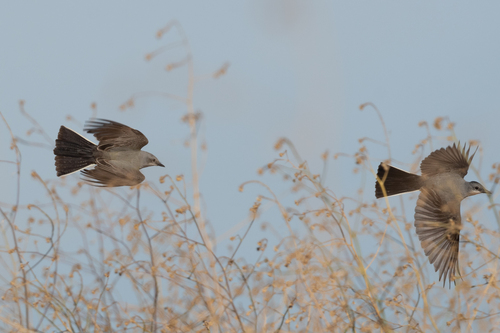
Western Kingbird (Tyrannus verticalis) Western Kingbird
Eastern Kingbird (Tyrannus tyrannus) Eastern Kingbird

Media

Loading…

In short

The Western Kingbird and Eastern Kingbird are similar in size but can be distinguished by their plumage and tail patterns. The Western Kingbird has a pale gray head and a yellow belly, while the Eastern Kingbird is more uniformly dark with a white-tipped tail.

Identification tips

  1. Look for the yellow belly and white outer tail feathers of the Western Kingbird. 2. Note the white-tipped tail and darker overall plumage of the Eastern Kingbird. 3. Listen for the sharp 'zeer' call of the Eastern Kingbird. 4. Consider the habitat: Western Kingbirds are more common in open western areas, while Eastern Kingbirds are found across North America near water.

Size

Both species are similar in size, typical of medium-sized flycatchers.

Plumage

Western Kingbirds have a pale gray head, yellow belly, and white outer tail feathers. Eastern Kingbirds are more uniformly dark gray to black above with a white underbelly and a distinctive white band at the tip of the tail.

Behaviour

Both species exhibit typical flycatcher behavior, such as aerial hawking for insects. However, Eastern Kingbirds are more likely to be seen in flocks during migration.

Habitat

Western Kingbirds are found in open areas with scattered trees in the western U.S., while Eastern Kingbirds prefer open fields and edges near water across North America.

Voice

Eastern Kingbirds have a more varied vocalization, including a sharp 'zeer' call, while Western Kingbirds have a more monotonous, chattering call.

Submit a better description

Use the same sections as the comparison. Your text is published immediately.

The Western Kingbird and Eastern Kingbird are similar in size but can be distinguished by their plumage and tail patterns. The Western Kingbird has a pale gray head and a yellow belly, while the Eastern Kingbird is more uniformly dark with a white-tipped tail.

  1. Look for the yellow belly and white outer tail feathers of the Western Kingbird. 2. Note the white-tipped tail and darker overall plumage of the Eastern Kingbird. 3. Listen for the sharp 'zeer' call of the Eastern Kingbird. 4. Consider the habitat: Western Kingbirds are more common in open western areas, while Eastern Kingbirds are found across North America near water.

Both species are similar in size, typical of medium-sized flycatchers.

Western Kingbirds have a pale gray head, yellow belly, and white outer tail feathers. Eastern Kingbirds are more uniformly dark gray to black above with a white underbelly and a distinctive white band at the tip of the tail.

Both species exhibit typical flycatcher behavior, such as aerial hawking for insects. However, Eastern Kingbirds are more likely to be seen in flocks during migration.

Western Kingbirds are found in open areas with scattered trees in the western U.S., while Eastern Kingbirds prefer open fields and edges near water across North America.

Eastern Kingbirds have a more varied vocalization, including a sharp 'zeer' call, while Western Kingbirds have a more monotonous, chattering call.

Discard your changes?

You have unsaved edits. If you leave now, those changes will be lost.

Western Kingbird · Eastern Kingbird · My Tricky Birds