Birdr

Western Marsh Harrier vs Eurasian Sparrowhawk

Circus aeruginosus versus Accipiter nisus

Play a quiz with Western Marsh Harrier and Eurasian Sparrowhawk
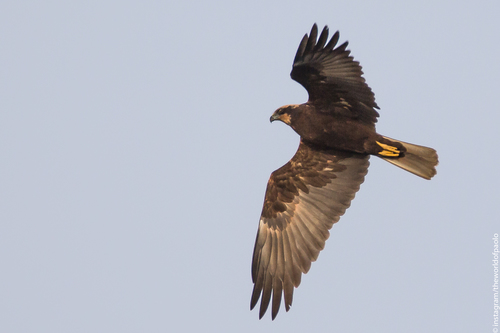
Western Marsh Harrier (Circus aeruginosus) Western Marsh Harrier
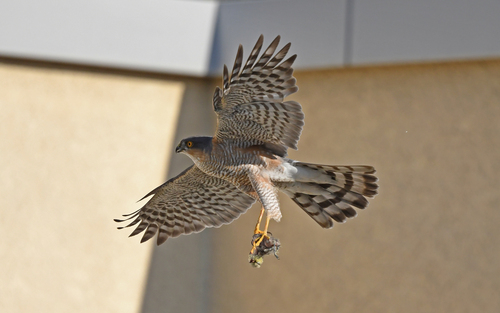
Eurasian Sparrowhawk (Accipiter nisus) Eurasian Sparrowhawk

Media

Loading…

In short

The Western Marsh Harrier and the Eurasian Sparrowhawk are both raptors but differ significantly in structure and behavior. The Marsh Harrier is larger with broader wings and a more buoyant flight, while the Sparrowhawk is smaller and more agile, often seen darting through woodlands.

Identification tips

1. Size and Structure: The Marsh Harrier is noticeably larger with broader wings. 2. Flight Style: Marsh Harriers have a slow, buoyant flight, while Sparrowhawks are fast and agile. 3. Habitat: Look for Marsh Harriers over wetlands and Sparrowhawks in wooded areas. 4. Plumage: Note the Marsh Harrier's uniform brown and pale head versus the Sparrowhawk's barred underparts and slate-blue or gray-brown upperparts.

Size

The Western Marsh Harrier is larger, with a wingspan of 115–130 cm, compared to the Eurasian Sparrowhawk's 58–80 cm.

Plumage

Western Marsh Harriers have a more uniform brown coloration with a pale head in adults, whereas Eurasian Sparrowhawks have slate-blue upperparts in males and gray-brown in females, with distinct barring on the underparts.

Behaviour

Western Marsh Harriers are often seen gliding low over wetlands, while Eurasian Sparrowhawks are more likely to be seen flying swiftly through forests or gardens.

Habitat

Western Marsh Harriers prefer open wetlands and reedbeds, whereas Eurasian Sparrowhawks are more adaptable, found in woodlands, gardens, and urban areas.

Voice

Vocalizations are not a primary distinguishing feature in the field; both species are generally silent, especially outside the breeding season.

Submit a better description

Use the same sections as the comparison. Your text is published immediately.

The Western Marsh Harrier and the Eurasian Sparrowhawk are both raptors but differ significantly in structure and behavior. The Marsh Harrier is larger with broader wings and a more buoyant flight, while the Sparrowhawk is smaller and more agile, often seen darting through woodlands.

1. Size and Structure: The Marsh Harrier is noticeably larger with broader wings. 2. Flight Style: Marsh Harriers have a slow, buoyant flight, while Sparrowhawks are fast and agile. 3. Habitat: Look for Marsh Harriers over wetlands and Sparrowhawks in wooded areas. 4. Plumage: Note the Marsh Harrier's uniform brown and pale head versus the Sparrowhawk's barred underparts and slate-blue or gray-brown upperparts.

The Western Marsh Harrier is larger, with a wingspan of 115–130 cm, compared to the Eurasian Sparrowhawk's 58–80 cm.

Western Marsh Harriers have a more uniform brown coloration with a pale head in adults, whereas Eurasian Sparrowhawks have slate-blue upperparts in males and gray-brown in females, with distinct barring on the underparts.

Western Marsh Harriers are often seen gliding low over wetlands, while Eurasian Sparrowhawks are more likely to be seen flying swiftly through forests or gardens.

Western Marsh Harriers prefer open wetlands and reedbeds, whereas Eurasian Sparrowhawks are more adaptable, found in woodlands, gardens, and urban areas.

Vocalizations are not a primary distinguishing feature in the field; both species are generally silent, especially outside the breeding season.

Discard your changes?

You have unsaved edits. If you leave now, those changes will be lost.

Western Marsh Harrier · Eurasian Sparrowhawk · My Tricky Birds