
Western Marsh Harrier vs Hen Harrier
Circus aeruginosus versus Circus cyaneus
Play a quiz with Western Marsh Harrier and Hen Harrier
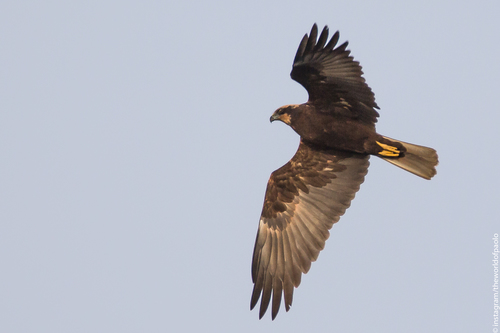 Western Marsh Harrier
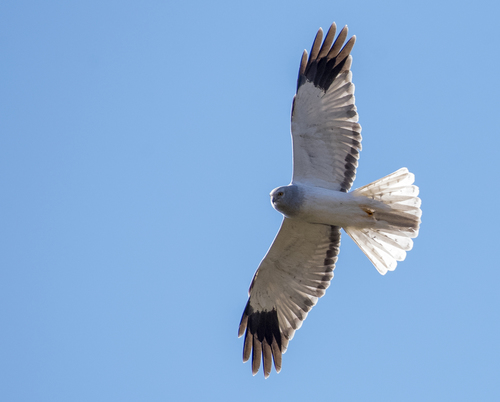 Hen Harrier
In short
The most reliable field mark to separate Western Marsh Harrier from Hen Harrier is the upperwing and body pattern in flight, especially in juveniles and females. Western Marsh Harrier females and juveniles show a solid, dark chocolate-brown body with a contrastingly pale head and shoulders, lacking the white rump and clear underwing barring of Hen Harrier. Hen Harrier females and juveniles ('ringtails') are brown above but always show a bold white rump and buff underparts with brown barring, plus a longer, slimmer wing and tail profile. Males are easier: Western Marsh Harrier males are three-toned (brown, grey, black) with no white rump, while Hen Harrier males are mostly pale grey and white with black wingtips and a white rump. Structure and flight style also help: Marsh Harrier is bulkier and broader-winged, Hen Harrier is slimmer and more buoyant.
Identification tips
- White rump patch: Only Hen Harrier (all ages and sexes) shows a bold white rump in flight; Western Marsh Harrier never does. This is the single best field mark, especially for females and juveniles.
- Underwing and body pattern (juveniles/females): Marsh Harrier juveniles/females are solid dark brown below with a pale head and shoulders, lacking the white rump and buff barring of Hen Harrier. Hen Harrier ringtails have buff underparts with brown barring and a contrasting white rump.
- Head and face pattern: Marsh Harrier females/juveniles have a pale yellowish head and shoulders, often sharply contrasting with the dark body, and a dark area around the eye. Hen Harrier ringtails have a less contrasting head, with no pale 'hood' and a more uniform brown face.
- Male plumage: Marsh Harrier males are three-toned (brown, grey, black) with a pale head, brown body, grey secondaries/tertials, and black wingtips. Hen Harrier males are pale grey above, white below, with black wingtips and a white rump—much paler and cleaner overall.
- Wing shape and flight: Marsh Harrier is bulkier and broader-winged, with slower, steadier wingbeats and a heavier, less buoyant flight. Hen Harrier is slimmer, with longer, narrower wings and a more agile, floating flight style.
- Tail shape: Hen Harrier has a longer, more tapering tail relative to body size; Marsh Harrier's tail is shorter and less tapered.
- Size: Marsh Harrier is larger and heavier, especially females. In direct comparison, Marsh Harrier looks bulkier and more imposing.
- Legs in flight: Marsh Harrier often dangles its legs noticeably while hunting; this is less obvious in Hen Harrier.
- Habitat context: If seen over extensive reedbeds or wetlands, Marsh Harrier is more likely; over moorland, upland grassland, or open farmland, Hen Harrier is more likely, especially outside the breeding season.
- Juvenile confusion: Juvenile Marsh Harrier can appear very dark, even blackish in rare morphs, but will still lack the white rump of Hen Harrier. Juvenile Hen Harrier always shows the white rump and a paler, barred belly.
- Facial disc: Hen Harrier has a subtle owl-like facial disc, giving a slightly 'flat-faced' look in close views, especially in females/juveniles. Marsh Harrier lacks this feature.
- Vocalizations: Only Hen Harrier is notably vocal, especially during food passes and display; Marsh Harrier is generally silent.
- Primary panel: Hen Harrier males show a sharp contrast between pale grey wings and black wingtips; Marsh Harrier males have a more blended, three-toned wing.
- Eye color: Adult Marsh Harrier females have a pale iris standing out in a dark face; Hen Harrier females have a less contrasting eye.
- When in doubt: If you see a harrier with a white rump, it's a Hen Harrier. If the bird is large, broad-winged, dark brown with a pale head and no white rump, it's a Western Marsh Harrier.
Size
Western Marsh Harrier is distinctly larger and bulkier than Hen Harrier. Marsh Harrier females are especially heavy (up to 800g), while Hen Harrier females average around 530g [wikidata]. Marsh Harrier length is 48–56 cm with a wingspan of 115–130 cm, compared to Hen Harrier's 41–52 cm and 97–122 cm wingspan [wikipedia]. In the field, Marsh Harrier often appears heavier-bodied, with broader wings and a less tapering tail. Hen Harrier is more slender, with longer, narrower wings and a longer tail relative to body size.
Plumage
- Juveniles and Females:
- Western Marsh Harrier juveniles and females are almost entirely dark chocolate-brown, with a conspicuously paler yellowish head and shoulders. The pale area can be sharply defined or washed out, but the face is always darker around the eye, making the pale iris stand out. There is no white rump. Juveniles have less yellow on the shoulders than females. Rare hypermelanic morphs can look almost all black in flight.
- Hen Harrier females and juveniles ('ringtails') are brown above with a bold white rump patch, and buff underparts with brown barring. The white rump is always present and obvious in flight. Juveniles have less distinct barring and darker secondaries, but still show the white rump and a generally paler underbody than Marsh Harrier.
- Males:
- Western Marsh Harrier males are reddish-brown with yellowish streaks, a pale head, and a three-toned wing: brown forewing, grey secondaries/tertials, and black primaries. No white rump.
- Hen Harrier males are pale grey above, white below (except for a grey upper breast), with black wingtips and a white rump. The wings are long and narrow, and the overall look is much paler and cleaner than Marsh Harrier males.
- In all ages: Only Hen Harrier shows a white rump; Marsh Harrier never does.
Behaviour
Both species hunt by gliding low over open ground with wings held in a shallow V, but Western Marsh Harrier often appears heavier and less agile, with broader wings and slower, steadier wingbeats. Hen Harrier is more buoyant and agile, with a tendency to quarter fields and moors in a more erratic, owl-like manner. Marsh Harrier may dangle its legs more obviously during hunting. Both species hunt small mammals and birds, but Hen Harrier relies more on mammals, while Marsh Harrier takes a broader range of prey including amphibians and reptiles.
Habitat
Both species can be found in open habitats like marshes and grasslands, but Western Marsh Harrier is more closely tied to wetlands and reedbeds, especially for breeding. Hen Harrier is more often seen over moorland, upland grassland, and open farmland, and is more migratory, vacating higher altitudes in winter. In areas where both occur, Marsh Harrier is more likely near extensive wetlands, while Hen Harrier is more widespread in drier open country.
Voice
Hen Harrier is described as a very vocal bird, with females giving a whistled 'piih-eh' when receiving food and an alarm call 'chit-it-it-it-it-et-it'. Males give a 'chek-chek-chek' and a bouncing 'chuk-uk-uk-uk' in display. No distinctive vocalizations are noted for Western Marsh Harrier in the sources, so calls are not a reliable field mark for separation.