
Birdr

Whinchat vs Northern Wheatear

Saxicola rubetra versus Oenanthe oenanthe

Play a quiz with Whinchat and Northern Wheatear
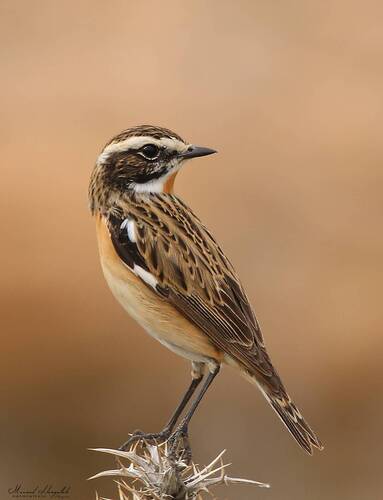
Whinchat (Saxicola rubetra) Whinchat
Northern Wheatear (Oenanthe oenanthe) Northern Wheatear

Media

Loading…

In short

The Whinchat and Northern Wheatear are both small, ground-dwelling birds often seen in open habitats. The most reliable field mark is the Whinchat's bold white supercilium and streaked upperparts, contrasting with the Wheatear's more uniform back and less pronounced facial markings. Both species have upright postures, but the Wheatear is generally paler and more robust.

Identification tips

  1. Look for the Whinchat's bold white supercilium and streaked upperparts. 2. Note the Northern Wheatear's more uniform back and distinctive tail pattern. 3. Consider habitat: Whinchats in grassy fields, Wheatears in rocky or open areas. 4. Listen for vocal differences: Whinchat's scratchy notes vs. Wheatear's melodic whistles.

Size

Both species are similar in size, but the Northern Wheatear appears slightly larger and more robust.

Plumage

The Whinchat has a bold white supercilium and streaked brown upperparts, while the Northern Wheatear has a more uniform grayish back and a less distinct supercilium. The Wheatear also shows a distinctive black and white tail pattern, which is less pronounced in the Whinchat.

Behaviour

Both species exhibit upright postures and are often seen perched on low shrubs or rocks. The Wheatear is more likely to be seen running on the ground.

Habitat

Whinchats prefer grassy fields and heathlands, whereas Northern Wheatears are found in a wider range of open habitats, including rocky areas and tundra.

Voice

The Whinchat's song is a series of varied, scratchy notes, while the Northern Wheatear's song is a more melodic, whistling sequence. Calls differ, with the Whinchat's being a 'chack' sound and the Wheatear's a 'chack-chack'.

Submit a better description

Use the same sections as the comparison. Your text is published immediately.

The Whinchat and Northern Wheatear are both small, ground-dwelling birds often seen in open habitats. The most reliable field mark is the Whinchat's bold white supercilium and streaked upperparts, contrasting with the Wheatear's more uniform back and less pronounced facial markings. Both species have upright postures, but the Wheatear is generally paler and more robust.

  1. Look for the Whinchat's bold white supercilium and streaked upperparts. 2. Note the Northern Wheatear's more uniform back and distinctive tail pattern. 3. Consider habitat: Whinchats in grassy fields, Wheatears in rocky or open areas. 4. Listen for vocal differences: Whinchat's scratchy notes vs. Wheatear's melodic whistles.

Both species are similar in size, but the Northern Wheatear appears slightly larger and more robust.

The Whinchat has a bold white supercilium and streaked brown upperparts, while the Northern Wheatear has a more uniform grayish back and a less distinct supercilium. The Wheatear also shows a distinctive black and white tail pattern, which is less pronounced in the Whinchat.

Both species exhibit upright postures and are often seen perched on low shrubs or rocks. The Wheatear is more likely to be seen running on the ground.

Whinchats prefer grassy fields and heathlands, whereas Northern Wheatears are found in a wider range of open habitats, including rocky areas and tundra.

The Whinchat's song is a series of varied, scratchy notes, while the Northern Wheatear's song is a more melodic, whistling sequence. Calls differ, with the Whinchat's being a 'chack' sound and the Wheatear's a 'chack-chack'.

Discard your changes?

You have unsaved edits. If you leave now, those changes will be lost.

Whinchat · Northern Wheatear · My Tricky Birds