
Whinchat vs Siberian Stonechat
Saxicola rubetra versus Saxicola maurus
Play a quiz with Whinchat and Siberian Stonechat
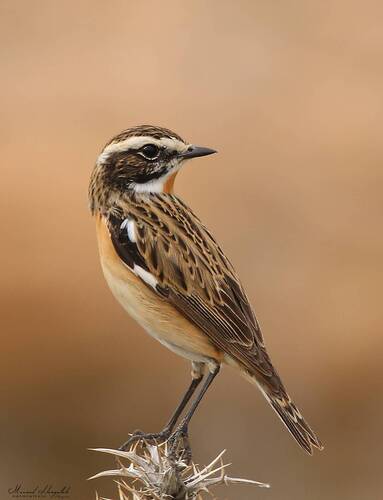 Whinchat
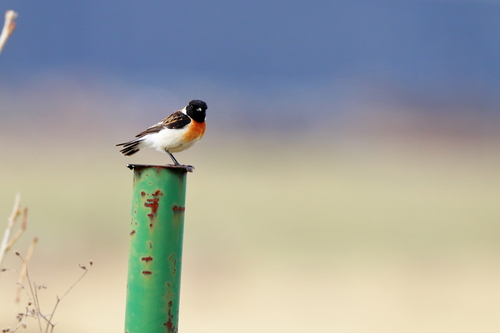 Siberian Stonechat
In short
The most reliable field mark to separate Whinchat from Siberian Stonechat is the rump color: Whinchat of all ages shows a brown, mottled rump matching the back, while Siberian Stonechat (especially females and immatures) has a pale, unstreaked orange-buff or white rump that stands out in flight. Both species have a strong pale supercilium, but Whinchat’s is broader and more striking, especially compared to female Siberian Stonechat. In perched views, Whinchat is slimmer with longer wingtips, while Siberian Stonechat appears more compact. Breeding males are easier to separate by face and collar pattern, but most quiz mistakes involve females or immatures, where rump and wing pattern are key. Always check the rump in flight and the supercilium and underparts when perched.
Identification tips
- Rump color in flight (all ages): Whinchat always shows a brown, streaked rump matching the back; Siberian Stonechat (especially females and immatures) has a pale, unstreaked orange-buff or white rump. This is the single best mark when the bird is flying away or flicking its tail.
- Supercilium (perched, all ages): Whinchat has a broad, strong white supercilium that stands out, especially in females and immatures. Siberian Stonechat’s supercilium is narrower and less contrasting, though in winter males it can be more obvious.
- Underparts (perched): Whinchat has a pale buff to whitish belly and often a paler breast, while Siberian Stonechat is generally whiter below but with less orange on the breast. Whinchat’s orange is more extensive and warmer in breeding males, but this is less reliable in females and immatures.
- Face pattern (breeding males): Whinchat male shows a blackish face mask with a strong white supercilium and malar stripe, and a bright orange-buff throat and breast. Siberian Stonechat male has a black head and back, a full white collar, and a white rump, with orange restricted to the throat.
- Wing patches (males and some females): Whinchat males (all year) and some females show small white wing patches on the greater and inner median coverts; Siberian Stonechat lacks this pattern but may show white in the scapulars or collar.
- Primary projection (structure): Whinchat has longer wingtips (primary projection) than Siberian Stonechat, giving it a more elongated, less 'dumpy' look when perched. This is subtle but can help when seen side-by-side.
- Tail pattern: Both species have blackish tails with white at the bases of the outer feathers, but the white is more extensive in Siberian Stonechat.
- Collar (breeding males): Siberian Stonechat shows a full white collar around the neck, while Whinchat has only a white malar stripe and supercilium, not a full collar.
- Breast color (breeding males): Whinchat has a bright orange-buff throat and breast; Siberian Stonechat’s orange is more restricted to the throat and less extensive.
- Moult timing (adults vs juveniles): Whinchat adults have a complete moult after breeding and before migration, while juveniles retain juvenile flight feathers with a partial body moult. Siberian Stonechat moult details are less diagnostic in the field.
- Jizz (overall impression): Whinchat appears slimmer and more elongated due to longer wings, especially when perched upright. Siberian Stonechat is more compact and upright.
- Habitat/context: In western Europe, Whinchat is much more likely in open grassland and upland habitats, while Siberian Stonechat is a rare vagrant. However, do not rely on habitat alone where both may occur.
- Seasonal confusion: In autumn and winter, both species become duller and more similar, but rump color and supercilium remain reliable.
- Sex differences: Female and immature Siberian Stonechat are most easily confused with Whinchat; always check the rump and supercilium.
- Pitfalls: Do not rely on underpart color alone, as both can appear pale below. Always use a combination of rump, supercilium, and wing pattern where possible.
Size
Both species are similar in size, close to European Robin, with Whinchat measuring 12–14 cm in length and weighing 13–26 g [wikipedia]. Siberian Stonechat is not given a precise measurement here but is described as comparable. In the field, Whinchat may appear slightly slimmer and less 'dumpy' than Siberian Stonechat, with longer primary projection (wingtips), but these differences are subtle and best used in combination with plumage marks.
Plumage
- Juvenile/immature and female birds in flight: The rump is the most diagnostic feature. Whinchat of all ages has a brown, streaked rump matching the back, while Siberian Stonechat (especially females and immatures) shows a pale, unstreaked orange-buff or white rump that contrasts with the darker back. This is most obvious when the bird is flying away or flicking its tail.
- Perched birds: Whinchat shows a broad, strong white supercilium and a pale, whitish belly. Siberian Stonechat’s supercilium is narrower and less contrasting, and the underparts are generally whiter with less orange on the breast. Breeding male Siberian Stonechat has a black head and back with a full white collar and white rump, while Whinchat male shows an orange-buff throat and breast, blackish face mask, and white supercilium, but lacks the full white collar and white rump.
- Wing pattern: Whinchat males (all year) and some females show small white wing patches on the greater and inner median coverts; Siberian Stonechat may show white in the scapulars or collar but not the same wing patch pattern. Both species have dark tails with white at the bases of the outer feathers, but this is more extensive in Siberian Stonechat.
- Seasonal changes: Whinchat males in winter resemble females but retain white wing patches. Siberian Stonechat males in winter develop a supercilium but can be separated by the white collar and rump.
Behaviour
Both species perch upright on shrubs or low vegetation and sally out to catch insects. Whinchat is noted for frequent tail and wing flicking, often flashing white in the tail and wings as a display. Siberian Stonechat behaves similarly but may appear slightly more compact and less active in tail flicking. Both use prominent perches, but Whinchat often looks more slender and elongated due to its longer wings.
Habitat
Whinchat breeds in open country across Europe and western Asia, favoring rough grassland, meadows, and upland pastures with scattered shrubs. Siberian Stonechat breeds further east, in the East Palearctic, and winters in the Old World tropics. In western Europe, Siberian Stonechat is a rare vagrant, so context can help: Whinchat is expected in open, grassy habitats with perches, while Siberian Stonechat is more likely in eastern or migratory contexts. However, habitat is not diagnostic where ranges overlap.