Birdr

Whiskered Tern vs Forster's Tern

Chlidonias hybrida versus Sterna forsteri

Play a quiz with Whiskered Tern and Forster's Tern
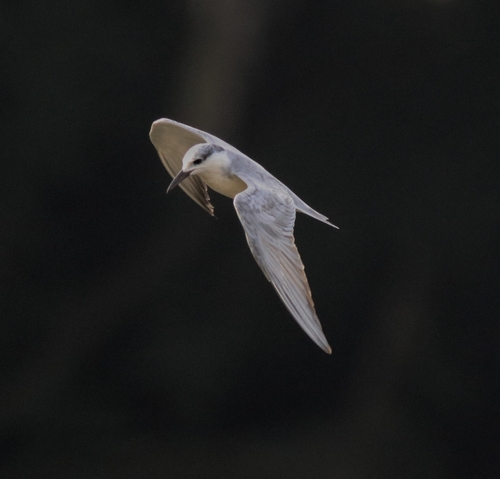
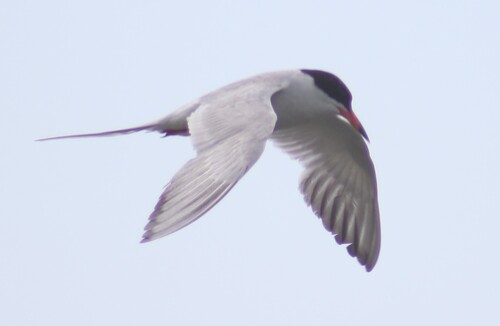
Whiskered Tern (Chlidonias hybrida) Whiskered Tern
Forster's Tern (Sterna forsteri) Forster's Tern

Media

Loading…

In short

Whiskered Tern and Forster's Tern can be distinguished by their tail shape and plumage. Whiskered Tern has a shorter, less forked tail and darker underparts, while Forster's Tern has a more deeply forked tail and lighter plumage. Both species have similar habitats but differ in vocalizations.

Identification tips

Size

Both species are medium-small terns, but Whiskered Tern is slightly more slender.

Plumage

Whiskered Tern has darker grey underparts with a black cap extending to the nape and white cheeks. In non-breeding plumage, it appears very pale with a dark-flecked crown. Forster's Tern is generally paler with a black cap and a more deeply forked tail, and in non-breeding plumage, it has a distinctive black eye patch.

Behaviour

Both species exhibit typical tern behavior, such as aerial-dipping for prey, but Whiskered Tern may appear more agile with its slightly more rounded wings.

Habitat

Both species are found in marshy environments, but Forster's Tern is more restricted to North America, often found in coastal marshes, while Whiskered Tern has a broader range including Europe, Asia, and Africa.

Voice

Whiskered Tern has a harsher, rasping call, while Forster's Tern's calls are less harsh and more melodic.

Submit a better description

Use the same sections as the comparison. Your text is published immediately.

Whiskered Tern and Forster's Tern can be distinguished by their tail shape and plumage. Whiskered Tern has a shorter, less forked tail and darker underparts, while Forster's Tern has a more deeply forked tail and lighter plumage. Both species have similar habitats but differ in vocalizations.

  • Tail shape: Whiskered Tern has a shorter, less forked tail; Forster's Tern has a deeply forked tail.
  • Plumage: Whiskered Tern is darker below in breeding plumage; Forster's Tern is paler.
  • Non-breeding plumage: Whiskered Tern has a dark-flecked crown; Forster's Tern has a black eye patch.
  • Vocalizations: Listen for Whiskered Tern's harsher calls compared to Forster's Tern.

Both species are medium-small terns, but Whiskered Tern is slightly more slender.

Whiskered Tern has darker grey underparts with a black cap extending to the nape and white cheeks. In non-breeding plumage, it appears very pale with a dark-flecked crown. Forster's Tern is generally paler with a black cap and a more deeply forked tail, and in non-breeding plumage, it has a distinctive black eye patch.

Both species exhibit typical tern behavior, such as aerial-dipping for prey, but Whiskered Tern may appear more agile with its slightly more rounded wings.

Both species are found in marshy environments, but Forster's Tern is more restricted to North America, often found in coastal marshes, while Whiskered Tern has a broader range including Europe, Asia, and Africa.

Whiskered Tern has a harsher, rasping call, while Forster's Tern's calls are less harsh and more melodic.

Discard your changes?

You have unsaved edits. If you leave now, those changes will be lost.

Whiskered Tern · Forster's Tern · My Tricky Birds