White-bellied Antbird vs Chestnut-backed Antbird
Myrmeciza longipes versus Poliocrania exsul
Play a quiz with White-bellied Antbird and Chestnut-backed Antbird
White-bellied Antbird
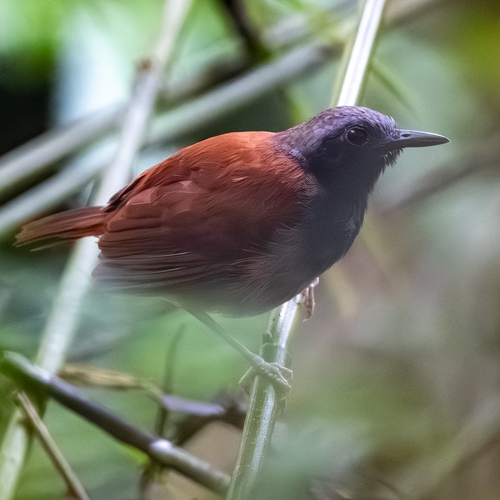
Chestnut-backed Antbird
In short
The White-bellied Antbird and Chestnut-backed Antbird can be distinguished by their plumage and habitat preferences. The White-bellied Antbird has a white belly and a black throat in males, whereas the Chestnut-backed Antbird features a more uniformly chestnut back and lacks the stark white belly. Both species inhabit dense forests, but the White-bellied Antbird is more tolerant of drier, fragmented habitats.
Identification tips
- Look for the white belly and black throat in male White-bellied Antbirds. 2. Note the uniform chestnut back of the Chestnut-backed Antbird. 3. Consider habitat: White-bellied Antbirds are more likely in drier, fragmented areas. 4. Use playback to confirm presence, especially for the White-bellied Antbird.
Size
Both species are similar in size, typical of antbirds, with no significant size difference noted.
Plumage
The White-bellied Antbird male has warm rufous upperparts, a black throat, a gray supercilium, and a white belly. Females have light cinnamon/brown underparts with black spotting on wing coverts. The Chestnut-backed Antbird has a more uniformly chestnut back and lacks the stark white belly, making it appear more uniformly colored.
Behaviour
Both species are shy and can be difficult to observe without playback. The Chestnut-backed Antbird is known to opportunistically attend army-ant swarms.
Habitat
The White-bellied Antbird prefers dense, tangled vegetation at forest edges and is more common in drier, deciduous forests and second-growth habitats. The Chestnut-backed Antbird is often found in small forest patches and has adapted well to fragmented landscapes.
Voice
Vocalizations are not detailed in the sources, but playback is often used to observe the White-bellied Antbird, suggesting distinct calls.
White-bellied Antbird · Chestnut-backed Antbird · My Tricky Birds