Birdr

White-breasted Waterhen vs Red-legged Crake

Amaurornis phoenicurus versus Rallina fasciata

Play a quiz with White-breasted Waterhen and Red-legged Crake
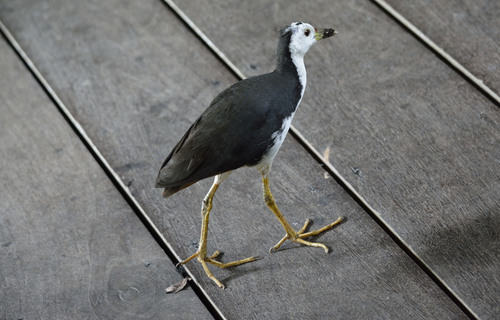
White-breasted Waterhen (Amaurornis phoenicurus) White-breasted Waterhen
Red-legged Crake (Rallina fasciata) Red-legged Crake

Media

Loading…

In short

The White-breasted Waterhen and Red-legged Crake can be distinguished primarily by their leg color and overall plumage. The Waterhen has yellowish legs and a distinctive white face and underparts, while the Crake features red legs and a more uniformly rufous body.

Identification tips

Leg color is a key feature: yellowish in the Waterhen, red in the Crake. Look for the white face and underparts in the Waterhen versus the uniform rufous plumage of the Crake. The Waterhen is more likely to be seen in open, wet areas, while the Crake is usually in dense forest. Listen for the Waterhen's loud calls, which can help locate it in its habitat.

Size

Both species are similar in size, typical of medium-sized rails.

Plumage

The White-breasted Waterhen has a striking white face and underparts with a dark upper body, whereas the Red-legged Crake is more uniformly rufous with faint barring on the flanks.

Behaviour

Both species are secretive and often found in dense vegetation, but the Waterhen is more likely to be seen foraging in open areas near water.

Habitat

The White-breasted Waterhen is often found in wetlands and marshy areas, while the Red-legged Crake prefers dense forest undergrowth and is less associated with open water.

Voice

The Waterhen has a loud, repetitive call, often heard at dawn and dusk. The Red-legged Crake's vocalizations are less well-documented but are generally softer and less conspicuous.

Submit a better description

Use the same sections as the comparison. Your text is published immediately.

The White-breasted Waterhen and Red-legged Crake can be distinguished primarily by their leg color and overall plumage. The Waterhen has yellowish legs and a distinctive white face and underparts, while the Crake features red legs and a more uniformly rufous body.

Leg color is a key feature: yellowish in the Waterhen, red in the Crake. Look for the white face and underparts in the Waterhen versus the uniform rufous plumage of the Crake. The Waterhen is more likely to be seen in open, wet areas, while the Crake is usually in dense forest. Listen for the Waterhen's loud calls, which can help locate it in its habitat.

Both species are similar in size, typical of medium-sized rails.

The White-breasted Waterhen has a striking white face and underparts with a dark upper body, whereas the Red-legged Crake is more uniformly rufous with faint barring on the flanks.

Both species are secretive and often found in dense vegetation, but the Waterhen is more likely to be seen foraging in open areas near water.

The White-breasted Waterhen is often found in wetlands and marshy areas, while the Red-legged Crake prefers dense forest undergrowth and is less associated with open water.

The Waterhen has a loud, repetitive call, often heard at dawn and dusk. The Red-legged Crake's vocalizations are less well-documented but are generally softer and less conspicuous.

Discard your changes?

You have unsaved edits. If you leave now, those changes will be lost.

White-breasted Waterhen · Red-legged Crake · My Tricky Birds