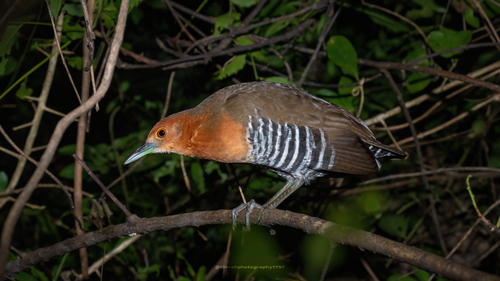
White-breasted Waterhen vs Slaty-legged Crake
Amaurornis phoenicurus versus Rallina eurizonoides
Play a quiz with White-breasted Waterhen and Slaty-legged Crake
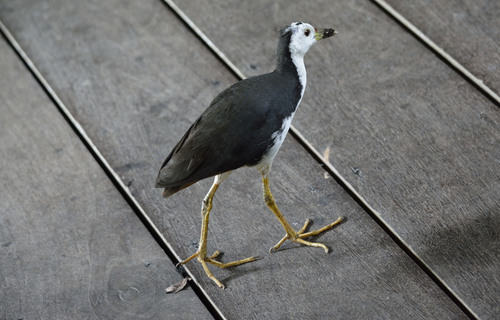
White-breasted Waterhen
Slaty-legged Crake
In short
The White-breasted Waterhen and the Slaty-legged Crake can be distinguished primarily by their plumage and leg color. The Waterhen has a striking white face and breast, while the Crake features a more uniform reddish-brown body with slaty legs. Both species are found in similar wetland habitats, but their vocalizations and behavior can also aid in identification.
Identification tips
Look for the white face and breast of the White-breasted Waterhen, which is absent in the Slaty-legged Crake. Note the slaty legs of the Crake compared to the Waterhen's yellowish legs. Listen for the Waterhen's loud calls, especially at dawn and dusk. Observe behavior: Waterhens are more likely to be seen in the open.
Size
Both species are similar in size, but the White-breasted Waterhen is slightly larger and bulkier.
Plumage
The White-breasted Waterhen has a distinctive white face, throat, and breast, contrasting with its dark upperparts and flanks. In contrast, the Slaty-legged Crake is more uniformly reddish-brown with a less contrasting appearance and lacks the white facial and breast markings.
Behaviour
Both species are secretive and often found skulking in dense vegetation. However, the White-breasted Waterhen is more likely to be seen walking openly in wetland areas, while the Slaty-legged Crake tends to stay hidden.
Habitat
Both species inhabit wetlands, but the White-breasted Waterhen is more adaptable and can also be found in gardens and agricultural areas. The Slaty-legged Crake prefers dense undergrowth in forested wetlands.
Voice
The White-breasted Waterhen has a loud, distinctive call often described as a series of harsh, repetitive notes. The Slaty-legged Crake's call is less well-documented but is generally softer and less conspicuous.
White-breasted Waterhen · Slaty-legged Crake · My Tricky Birds