Birdr

White-browed Fantail vs Dimorphic Fantail

Rhipidura aureola versus Rhipidura brachyrhyncha

Play a quiz with White-browed Fantail and Dimorphic Fantail
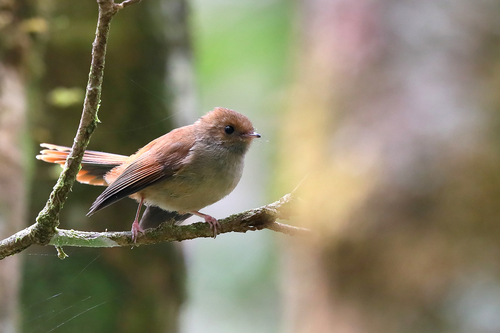
White-browed Fantail (Rhipidura aureola) White-browed Fantail
Dimorphic Fantail (Rhipidura brachyrhyncha) Dimorphic Fantail

Media

Loading…

In short

The White-browed Fantail and Dimorphic Fantail are both small, active birds with distinctive fan-shaped tails. The White-browed Fantail is best identified by its prominent white supercilium and contrasting dark face, while the Dimorphic Fantail lacks such a stark facial pattern. Both species are agile and often seen flitting about in search of insects.

Identification tips

  1. Look for the white supercilium on the White-browed Fantail. 2. Note the habitat: White-browed prefers open areas, Dimorphic is more montane. 3. Observe behavior: both are active, but habitat can guide identification. 4. Vocalization differences are subtle and not well-documented.

Size

Both species are similar in size, typical of fantails, with no significant difference in overall dimensions.

Plumage

The White-browed Fantail has a notable white supercilium and a darker face, providing a strong contrast. The Dimorphic Fantail, however, does not have such a pronounced supercilium and generally exhibits more uniform facial plumage.

Behaviour

Both species display typical fantail behavior, actively flitting and fanning their tails as they forage for insects. They are often seen in similar energetic and acrobatic flight patterns.

Habitat

The White-browed Fantail is typically found in open woodlands and scrub, while the Dimorphic Fantail prefers montane forests. This habitat preference can be a useful clue when identifying these species in the field.

Voice

Vocalizations are not well-documented for differentiation, but both species are known for their musical calls. Specific differences in song are not clearly noted in available sources.

Submit a better description

Use the same sections as the comparison. Your text is published immediately.

The White-browed Fantail and Dimorphic Fantail are both small, active birds with distinctive fan-shaped tails. The White-browed Fantail is best identified by its prominent white supercilium and contrasting dark face, while the Dimorphic Fantail lacks such a stark facial pattern. Both species are agile and often seen flitting about in search of insects.

  1. Look for the white supercilium on the White-browed Fantail. 2. Note the habitat: White-browed prefers open areas, Dimorphic is more montane. 3. Observe behavior: both are active, but habitat can guide identification. 4. Vocalization differences are subtle and not well-documented.

Both species are similar in size, typical of fantails, with no significant difference in overall dimensions.

The White-browed Fantail has a notable white supercilium and a darker face, providing a strong contrast. The Dimorphic Fantail, however, does not have such a pronounced supercilium and generally exhibits more uniform facial plumage.

Both species display typical fantail behavior, actively flitting and fanning their tails as they forage for insects. They are often seen in similar energetic and acrobatic flight patterns.

The White-browed Fantail is typically found in open woodlands and scrub, while the Dimorphic Fantail prefers montane forests. This habitat preference can be a useful clue when identifying these species in the field.

Vocalizations are not well-documented for differentiation, but both species are known for their musical calls. Specific differences in song are not clearly noted in available sources.

Discard your changes?

You have unsaved edits. If you leave now, those changes will be lost.

White-browed Fantail · Dimorphic Fantail · My Tricky Birds