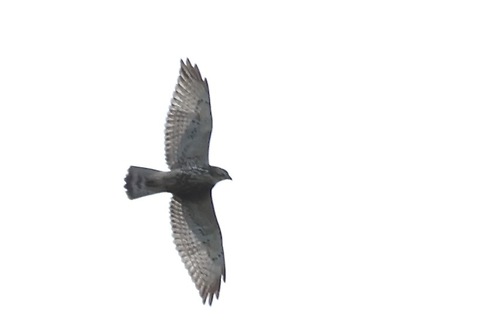
Birdr

White-browed Hawk vs Broad-winged Hawk

Leucopternis kuhli versus Buteo platypterus

Play a quiz with White-browed Hawk and Broad-winged Hawk
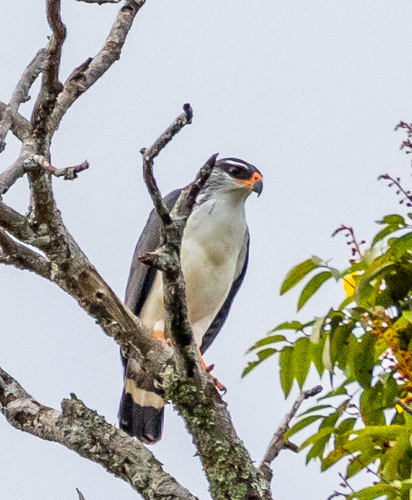
White-browed Hawk (Leucopternis kuhli) White-browed Hawk
Broad-winged Hawk (Buteo platypterus) Broad-winged Hawk

Media

Loading…

In short

The White-browed Hawk and the Broad-winged Hawk can be distinguished by their structure and plumage. The White-browed Hawk has a distinctive white supercilium and a more compact body, while the Broad-winged Hawk is larger with broader wings and a more varied plumage pattern.

Identification tips

1. Look for the white supercilium on the White-browed Hawk. 2. Note the size and wing shape; the Broad-winged Hawk is larger with broader wings. 3. Consider habitat; White-browed Hawks prefer tropical forests, while Broad-winged Hawks are more versatile. 4. Listen for the Broad-winged Hawk's distinctive whistle if vocalizations are heard.

Size

The Broad-winged Hawk is generally larger and bulkier than the White-browed Hawk, with broader wings and a more robust build.

Plumage

The White-browed Hawk features a prominent white supercilium and a mostly black face, while the Broad-winged Hawk exhibits more varied plumage, including light and dark morphs, and lacks the distinct white brow.

Behaviour

Both species are generally similar in behavior, being typical of hawks with soaring and gliding flight patterns.

Habitat

The White-browed Hawk is typically found in tropical lowland forests, whereas the Broad-winged Hawk is more adaptable, inhabiting a variety of wooded areas including deciduous and mixed forests.

Voice

The Broad-winged Hawk is known for its high-pitched, two-part whistle, while the White-browed Hawk's vocalizations are less well-documented but are not noted for being distinctive.

Submit a better description

Use the same sections as the comparison. Your text is published immediately.

The White-browed Hawk and the Broad-winged Hawk can be distinguished by their structure and plumage. The White-browed Hawk has a distinctive white supercilium and a more compact body, while the Broad-winged Hawk is larger with broader wings and a more varied plumage pattern.

1. Look for the white supercilium on the White-browed Hawk. 2. Note the size and wing shape; the Broad-winged Hawk is larger with broader wings. 3. Consider habitat; White-browed Hawks prefer tropical forests, while Broad-winged Hawks are more versatile. 4. Listen for the Broad-winged Hawk's distinctive whistle if vocalizations are heard.

The Broad-winged Hawk is generally larger and bulkier than the White-browed Hawk, with broader wings and a more robust build.

The White-browed Hawk features a prominent white supercilium and a mostly black face, while the Broad-winged Hawk exhibits more varied plumage, including light and dark morphs, and lacks the distinct white brow.

Both species are generally similar in behavior, being typical of hawks with soaring and gliding flight patterns.

The White-browed Hawk is typically found in tropical lowland forests, whereas the Broad-winged Hawk is more adaptable, inhabiting a variety of wooded areas including deciduous and mixed forests.

The Broad-winged Hawk is known for its high-pitched, two-part whistle, while the White-browed Hawk's vocalizations are less well-documented but are not noted for being distinctive.

Discard your changes?

You have unsaved edits. If you leave now, those changes will be lost.

White-browed Hawk · Broad-winged Hawk · My Tricky Birds