Birdr

White-crested Elaenia vs Hammond's Flycatcher

Elaenia albiceps versus Empidonax hammondii

Play a quiz with White-crested Elaenia and Hammond's Flycatcher
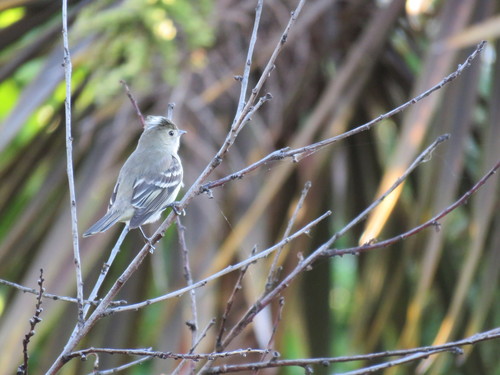
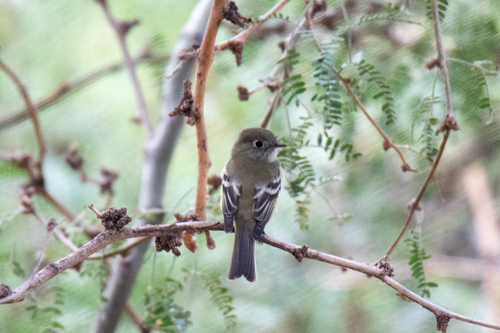
White-crested Elaenia (Elaenia albiceps) White-crested Elaenia
Hammond's Flycatcher (Empidonax hammondii) Hammond's Flycatcher

Media

Loading…

In short

The White-crested Elaenia and Hammond's Flycatcher can be distinguished by their structure and behavior. The White-crested Elaenia has a more prominent crest and is often found in more open habitats, while Hammond's Flycatcher has a shorter bill and prefers mature coniferous forests.

Identification tips

  1. Look for the white crest on the White-crested Elaenia, especially in open habitats. 2. Note the shorter bill and more compact structure of Hammond's Flycatcher. 3. Observe behavior: Hammond's is more likely to be seen foraging in flight in dense forests. 4. Consider habitat: White-crested Elaenia in open areas, Hammond's in mature conifers.

Size

Both species are small flycatchers, but Hammond's Flycatcher tends to be slightly smaller and more compact.

Plumage

White-crested Elaenia typically shows a more pronounced white crest and a paler underbelly, while Hammond's Flycatcher has a more uniform grayish-green plumage with less contrast between the upperparts and underparts.

Behaviour

White-crested Elaenia is more likely to be seen in open areas and is less reliant on aerial foraging compared to Hammond's Flycatcher, which primarily catches insects on the wing.

Habitat

White-crested Elaenia is often found in open woodlands and edges, whereas Hammond's Flycatcher prefers mature, old-growth coniferous forests.

Voice

Vocalizations are not a primary distinguishing feature, but Hammond's Flycatcher has a soft, whistled call that can be difficult to distinguish from similar species.

Submit a better description

Use the same sections as the comparison. Your text is published immediately.

The White-crested Elaenia and Hammond's Flycatcher can be distinguished by their structure and behavior. The White-crested Elaenia has a more prominent crest and is often found in more open habitats, while Hammond's Flycatcher has a shorter bill and prefers mature coniferous forests.

  1. Look for the white crest on the White-crested Elaenia, especially in open habitats. 2. Note the shorter bill and more compact structure of Hammond's Flycatcher. 3. Observe behavior: Hammond's is more likely to be seen foraging in flight in dense forests. 4. Consider habitat: White-crested Elaenia in open areas, Hammond's in mature conifers.

Both species are small flycatchers, but Hammond's Flycatcher tends to be slightly smaller and more compact.

White-crested Elaenia typically shows a more pronounced white crest and a paler underbelly, while Hammond's Flycatcher has a more uniform grayish-green plumage with less contrast between the upperparts and underparts.

White-crested Elaenia is more likely to be seen in open areas and is less reliant on aerial foraging compared to Hammond's Flycatcher, which primarily catches insects on the wing.

White-crested Elaenia is often found in open woodlands and edges, whereas Hammond's Flycatcher prefers mature, old-growth coniferous forests.

Vocalizations are not a primary distinguishing feature, but Hammond's Flycatcher has a soft, whistled call that can be difficult to distinguish from similar species.

Discard your changes?

You have unsaved edits. If you leave now, those changes will be lost.

White-crested Elaenia · Hammond's Flycatcher · My Tricky Birds