Birdr

White-eared Bulbul vs Himalayan Bulbul

Pycnonotus leucotis versus Pycnonotus leucogenys

Play a quiz with White-eared Bulbul and Himalayan Bulbul

White-eared Bulbul (Pycnonotus leucotis) White-eared Bulbul
Himalayan Bulbul (Pycnonotus leucogenys) Himalayan Bulbul

Media

Loading…

In short

The White-eared Bulbul and Himalayan Bulbul are similar in appearance but can be distinguished by their geographic range and subtle plumage differences. The White-eared Bulbul is found in western and central India, while the Himalayan Bulbul inhabits the Himalayan foothills. Key differences include the white cheek patch of the White-eared Bulbul versus the more extensive white face of the Himalayan Bulbul.

Identification tips

  1. Check location: White-eared Bulbul in western/central India, Himalayan Bulbul in the Himalayan foothills. 2. Look for facial markings: White-eared has a white cheek patch; Himalayan has an extensive white face. 3. Observe plumage: White-eared has a greyish body; Himalayan has a brownish body. 4. Note behavior: Both species are active and often in small groups.

Size

Both species are similar in size, typical of bulbuls, with no significant size difference to easily distinguish them.

Plumage

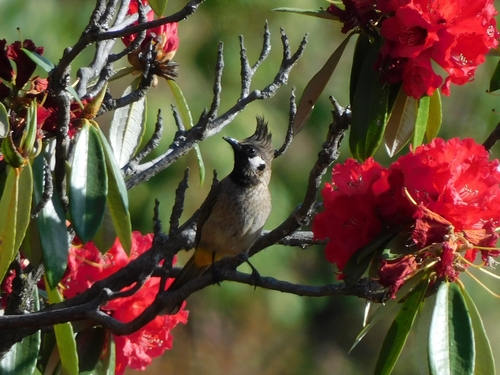
The White-eared Bulbul has a distinctive white cheek patch and a black head, contrasting with its greyish body. The Himalayan Bulbul features a more extensive white face with a black crest and a brownish body. Both have a yellow vent, but the Himalayan Bulbul's white facial area is more pronounced.

Behaviour

Both species are active and often seen in pairs or small flocks. They feed on fruits and insects, occasionally descending to the ground for food.

Habitat

The White-eared Bulbul is found in drier habitats such as gardens and open woodlands in western and central India. In contrast, the Himalayan Bulbul is associated with shrubberies, hilly slopes, and forest edges in the Himalayan foothills.

Voice

Both species have melodious calls, but specific vocal differences are not well-documented. Observers should rely on visual cues for identification.

Submit a better description

Use the same sections as the comparison. Your text is published immediately.

The White-eared Bulbul and Himalayan Bulbul are similar in appearance but can be distinguished by their geographic range and subtle plumage differences. The White-eared Bulbul is found in western and central India, while the Himalayan Bulbul inhabits the Himalayan foothills. Key differences include the white cheek patch of the White-eared Bulbul versus the more extensive white face of the Himalayan Bulbul.

  1. Check location: White-eared Bulbul in western/central India, Himalayan Bulbul in the Himalayan foothills. 2. Look for facial markings: White-eared has a white cheek patch; Himalayan has an extensive white face. 3. Observe plumage: White-eared has a greyish body; Himalayan has a brownish body. 4. Note behavior: Both species are active and often in small groups.

Both species are similar in size, typical of bulbuls, with no significant size difference to easily distinguish them.

The White-eared Bulbul has a distinctive white cheek patch and a black head, contrasting with its greyish body. The Himalayan Bulbul features a more extensive white face with a black crest and a brownish body. Both have a yellow vent, but the Himalayan Bulbul's white facial area is more pronounced.

Both species are active and often seen in pairs or small flocks. They feed on fruits and insects, occasionally descending to the ground for food.

The White-eared Bulbul is found in drier habitats such as gardens and open woodlands in western and central India. In contrast, the Himalayan Bulbul is associated with shrubberies, hilly slopes, and forest edges in the Himalayan foothills.

Both species have melodious calls, but specific vocal differences are not well-documented. Observers should rely on visual cues for identification.

Discard your changes?

You have unsaved edits. If you leave now, those changes will be lost.

White-eared Bulbul · Himalayan Bulbul · My Tricky Birds