Birdr

White-faced Ibis vs Bare-faced Ibis

Plegadis chihi versus Phimosus infuscatus

Play a quiz with White-faced Ibis and Bare-faced Ibis
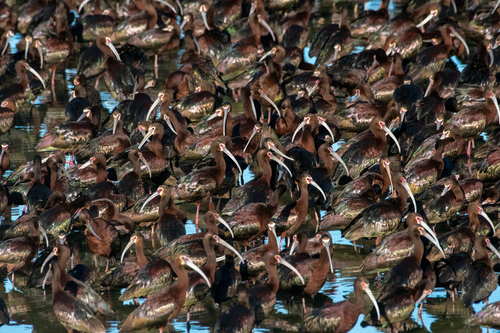
White-faced Ibis (Plegadis chihi) White-faced Ibis
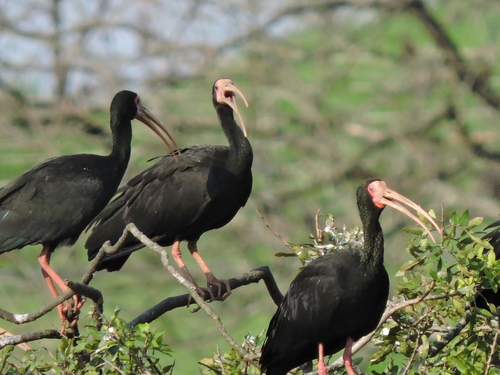
Bare-faced Ibis (Phimosus infuscatus) Bare-faced Ibis

Media

Loading…

In short

The White-faced Ibis and Bare-faced Ibis are both medium-sized wading birds, but they can be distinguished by facial features and habitat preferences. The White-faced Ibis has a distinctive white border around its face during the breeding season, while the Bare-faced Ibis lacks this feature and has a more uniform dark face.

Identification tips

  1. Look for the white facial border on the White-faced Ibis during the breeding season. 2. Note the uniform dark face of the Bare-faced Ibis. 3. Consider the location: White-faced Ibis is more likely in North America, while Bare-faced Ibis is found in South America.

Size

Both species are similar in size, typical of medium-sized ibises.

Plumage

The White-faced Ibis in breeding plumage has a white border around its face, contrasting with its dark body. The Bare-faced Ibis has a uniformly dark face and body without the white facial border.

Behaviour

Both species exhibit similar foraging behavior, probing in wetlands for food.

Habitat

White-faced Ibis prefers freshwater wetlands, especially in the western United States, while the Bare-faced Ibis is more commonly found in South American wetlands.

Voice

Vocalizations are not a primary distinguishing feature between these two species.

Submit a better description

Use the same sections as the comparison. Your text is published immediately.

The White-faced Ibis and Bare-faced Ibis are both medium-sized wading birds, but they can be distinguished by facial features and habitat preferences. The White-faced Ibis has a distinctive white border around its face during the breeding season, while the Bare-faced Ibis lacks this feature and has a more uniform dark face.

  1. Look for the white facial border on the White-faced Ibis during the breeding season. 2. Note the uniform dark face of the Bare-faced Ibis. 3. Consider the location: White-faced Ibis is more likely in North America, while Bare-faced Ibis is found in South America.

Both species are similar in size, typical of medium-sized ibises.

The White-faced Ibis in breeding plumage has a white border around its face, contrasting with its dark body. The Bare-faced Ibis has a uniformly dark face and body without the white facial border.

Both species exhibit similar foraging behavior, probing in wetlands for food.

White-faced Ibis prefers freshwater wetlands, especially in the western United States, while the Bare-faced Ibis is more commonly found in South American wetlands.

Vocalizations are not a primary distinguishing feature between these two species.

Discard your changes?

You have unsaved edits. If you leave now, those changes will be lost.

White-faced Ibis · Bare-faced Ibis · My Tricky Birds