Birdr

White Hawk vs Black-faced Hawk

Pseudastur albicollis versus Leucopternis melanops

Play a quiz with White Hawk and Black-faced Hawk
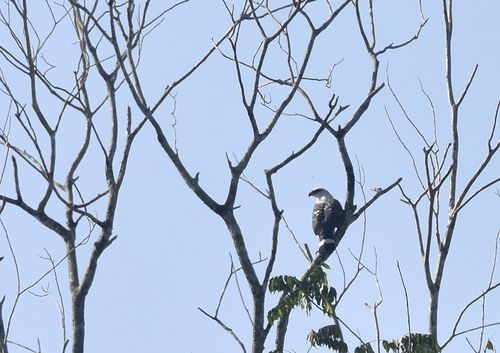
White Hawk (Pseudastur albicollis) White Hawk
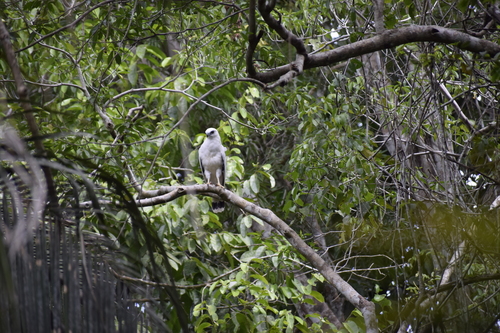
Black-faced Hawk (Leucopternis melanops) Black-faced Hawk

Media

Loading…

In short

The White Hawk and Black-faced Hawk can be distinguished primarily by their facial markings and overall plumage coloration. The White Hawk is mostly white with a gray cere, while the Black-faced Hawk has a distinctive black mask and more contrasting plumage. Both species are forest-dwelling raptors, but their appearance and behavior offer clues for identification.

Identification tips

  1. Look for the black facial mask on the Black-faced Hawk, absent in the White Hawk. 2. Note the mostly white plumage of the White Hawk, compared to the more patterned appearance of the Black-faced Hawk. 3. Observe behavior: both species may be seen soaring, but the White Hawk is more likely to be seen at forest edges.

Size

Both species are similar in size, typical of medium-sized hawks, but the White Hawk may appear slightly bulkier.

Plumage

The White Hawk is mostly white, with variations depending on subspecies, such as black on the mantle and tail in some. The Black-faced Hawk has a striking black facial mask, white underparts, and contrasting dark upperparts, making it more patterned than the White Hawk.

Behaviour

Both species are often seen soaring or perched at forest edges. The White Hawk is known to feed heavily on reptiles, while specific prey preferences for the Black-faced Hawk are less documented.

Habitat

Both species inhabit forested regions, but the White Hawk is more frequently observed at forest edges or soaring overhead.

Submit a better description

Use the same sections as the comparison. Your text is published immediately.

The White Hawk and Black-faced Hawk can be distinguished primarily by their facial markings and overall plumage coloration. The White Hawk is mostly white with a gray cere, while the Black-faced Hawk has a distinctive black mask and more contrasting plumage. Both species are forest-dwelling raptors, but their appearance and behavior offer clues for identification.

  1. Look for the black facial mask on the Black-faced Hawk, absent in the White Hawk. 2. Note the mostly white plumage of the White Hawk, compared to the more patterned appearance of the Black-faced Hawk. 3. Observe behavior: both species may be seen soaring, but the White Hawk is more likely to be seen at forest edges.

Both species are similar in size, typical of medium-sized hawks, but the White Hawk may appear slightly bulkier.

The White Hawk is mostly white, with variations depending on subspecies, such as black on the mantle and tail in some. The Black-faced Hawk has a striking black facial mask, white underparts, and contrasting dark upperparts, making it more patterned than the White Hawk.

Both species are often seen soaring or perched at forest edges. The White Hawk is known to feed heavily on reptiles, while specific prey preferences for the Black-faced Hawk are less documented.

Both species inhabit forested regions, but the White Hawk is more frequently observed at forest edges or soaring overhead.

Discard your changes?

You have unsaved edits. If you leave now, those changes will be lost.

White Hawk · Black-faced Hawk · My Tricky Birds