
White-winged Black Tern vs Arctic Tern
Chlidonias leucopterus versus Sterna paradisaea
Play a quiz with White-winged Black Tern and Arctic Tern
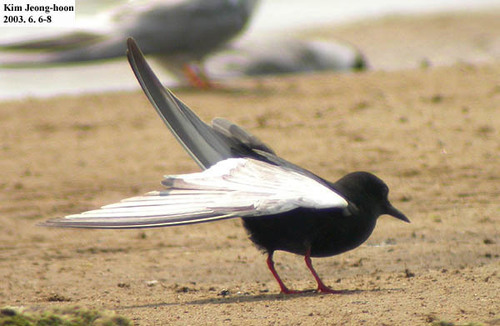
White-winged Black Tern
Arctic Tern
In short
The White-winged Black Tern and Arctic Tern can be distinguished by their wing patterns and tail shapes. The White-winged Black Tern has distinctive white wings and a shorter tail, while the Arctic Tern has a long, deeply forked tail and lacks the white wing patches.
Identification tips
1. Wing pattern: Look for white wing patches on White-winged Black Terns, absent in Arctic Terns. 2. Tail shape: Arctic Terns have a long, deeply forked tail, while White-winged Black Terns have a shorter tail. 3. Habitat: Consider the habitat; Arctic Terns are more coastal, while White-winged Black Terns are often inland. 4. Behavior: Note foraging style; Arctic Terns hover and dive, while White-winged Black Terns forage over wetlands. 5. Vocalization: Listen for the sharp calls of the Arctic Tern compared to the softer calls of the White-winged Black Tern.
Size
Both species are similar in size, but the Arctic Tern appears more slender with longer wings and tail.
Plumage
In breeding plumage, the White-winged Black Tern features striking white wings and a black head and body. The Arctic Tern has a uniformly grey body with a black cap and lacks the white wing patches. Non-breeding White-winged Black Terns have a more mottled appearance compared to the cleaner grey of the Arctic Tern.
Behaviour
Both species are agile fliers, but the Arctic Tern is known for its long migratory flights, often seen hovering and diving for fish. The White-winged Black Tern is more likely to be seen foraging over freshwater habitats.
Habitat
White-winged Black Terns are typically found over freshwater wetlands during breeding, while Arctic Terns prefer coastal and marine environments, especially during migration.
Voice
Arctic Terns have a sharp, high-pitched call, often described as 'kee-arr'. White-winged Black Terns have a softer, more chattering call.