Birdr

White-winged Dove vs Mourning Dove

Zenaida asiatica versus Zenaida macroura

Play a quiz with White-winged Dove and Mourning Dove
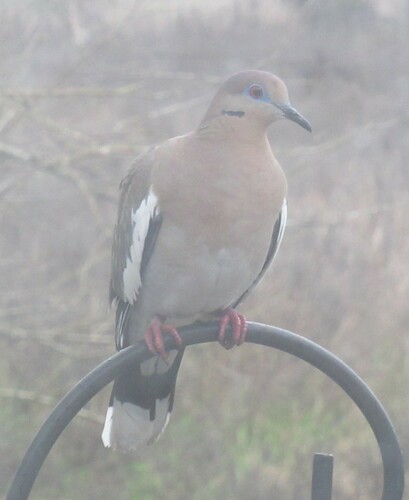
White-winged Dove (Zenaida asiatica) White-winged Dove
Mourning Dove (Zenaida macroura) Mourning Dove

Media

Loading…

In short

The White-winged Dove and Mourning Dove are both medium-sized doves, but can be distinguished by the White-winged Dove's prominent white wing patches and the Mourning Dove's long, pointed tail. The White-winged Dove is more robust, while the Mourning Dove is more slender with a distinctively mournful call.

Identification tips

  1. Look for white wing patches in the White-winged Dove, especially in flight. 2. Note the long, pointed tail of the Mourning Dove. 3. Listen for the mournful coo of the Mourning Dove. 4. Observe the blue eye ring on the White-winged Dove. 5. Consider habitat: White-winged Doves are more common in the southwest, while Mourning Doves are widespread.

Size

White-winged Dove is generally more robust and slightly larger than the slender Mourning Dove.

Plumage

White-winged Dove has distinctive white wing patches visible in flight and a blue eye ring. Mourning Dove lacks these white patches and has a more uniform brownish-gray plumage with a long, pointed tail.

Behaviour

Both species exhibit similar behaviors, such as ground foraging and perching in trees. However, the Mourning Dove is more commonly seen in open habitats and urban areas.

Habitat

White-winged Dove is often found in desert habitats and urban areas in the southwestern U.S., while Mourning Dove is a habitat generalist, found across North America in open and suburban areas.

Voice

Mourning Dove has a distinctive, mournful cooing call, which is a key identifier. White-winged Dove's call is less distinctive and not as mournful.

Submit a better description

Use the same sections as the comparison. Your text is published immediately.

The White-winged Dove and Mourning Dove are both medium-sized doves, but can be distinguished by the White-winged Dove's prominent white wing patches and the Mourning Dove's long, pointed tail. The White-winged Dove is more robust, while the Mourning Dove is more slender with a distinctively mournful call.

  1. Look for white wing patches in the White-winged Dove, especially in flight. 2. Note the long, pointed tail of the Mourning Dove. 3. Listen for the mournful coo of the Mourning Dove. 4. Observe the blue eye ring on the White-winged Dove. 5. Consider habitat: White-winged Doves are more common in the southwest, while Mourning Doves are widespread.

White-winged Dove is generally more robust and slightly larger than the slender Mourning Dove.

White-winged Dove has distinctive white wing patches visible in flight and a blue eye ring. Mourning Dove lacks these white patches and has a more uniform brownish-gray plumage with a long, pointed tail.

Both species exhibit similar behaviors, such as ground foraging and perching in trees. However, the Mourning Dove is more commonly seen in open habitats and urban areas.

White-winged Dove is often found in desert habitats and urban areas in the southwestern U.S., while Mourning Dove is a habitat generalist, found across North America in open and suburban areas.

Mourning Dove has a distinctive, mournful cooing call, which is a key identifier. White-winged Dove's call is less distinctive and not as mournful.

Discard your changes?

You have unsaved edits. If you leave now, those changes will be lost.

White-winged Dove · Mourning Dove · My Tricky Birds