
White's Thrush vs Scaly Thrush
Zoothera aurea versus Zoothera dauma
Play a quiz with White's Thrush and Scaly Thrush
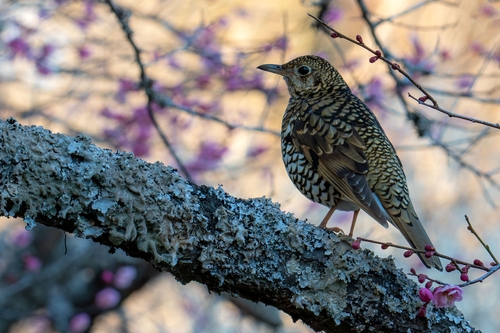 White's Thrush
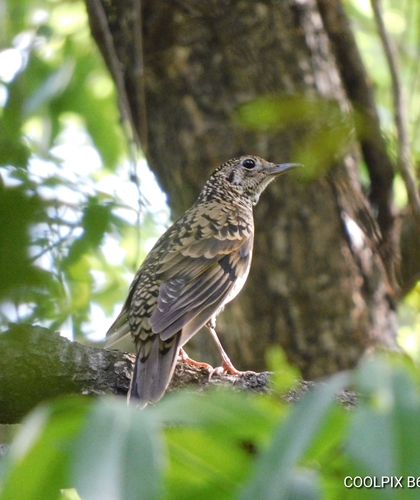 Scaly Thrush
In short
White's Thrush and Scaly Thrush are extremely similar in the field, with both showing bold black scaling on a pale background and a diagnostic black band on the white underwing in flight. This underwing pattern is shared by both species (and others in Zoothera), so it cannot be used to separate them. Both sexes and all ages are similar, and their songs are likewise nearly identical. In practice, reliable field separation is not possible based on plumage or structure alone; range, habitat, and subtle differences in local abundance may be more helpful, but even these can overlap where their distributions meet. Most quiz mix-ups are due to the lack of clear visual differences, especially in flight or with immature birds.
Identification tips
- Underwing pattern: Both species show a bold black band on a white underwing in flight, which is diagnostic for the genus but not for separating these two species. This mark applies to all ages and sexes.
- Body scaling: Both have heavy black scaling on a pale white or yellowish background, with no reliable differences in the shape, size, or density of the scaling.
- Juvenile/immature plumage: No documented differences in juvenile or first-winter upperwing or body pattern between the two species; both are heavily scaled and show the same underwing pattern in flight.
- Sexual dimorphism: Both species are sexually monomorphic; males and females look alike.
- Size and structure: Both are large thrushes (27–31 cm), with similar proportions, bill shape, and tail length. No structural differences are useful for field separation.
- Song and calls: Both sing a loud, mechanical whistle with long pauses, and there are no described differences in vocalizations.
- Flight style: Both species flush from the ground with strong, direct flight, showing the underwing pattern. No difference in flight jizz is described.
- Habitat and range: Where their ranges overlap, habitat is not a reliable separator. White's Thrush is more migratory, while Scaly Thrush is more resident or a short-distance migrant, but both occur in similar woodland habitats.
- Subspecies confusion: Some subspecies of Scaly Thrush (e.g., Z. imbricata, Z. neilgherriensis) are more distinctive, but the nominate forms of both species are not separable by plumage or structure.
- Pitfalls: Most field guides and sources agree that these two species cannot be reliably separated by visual field marks in areas of overlap. Focus on range, season, and local abundance for best guesses, but accept that some individuals will remain unidentified.
- Quiz context: If you are presented with a photo or description of a typical, scaled Zoothera thrush with a black underwing band, and no range or context is given, it is generally not possible to assign it to White's or Scaly with confidence.
- Community advice: Experienced birders often rely on location and date rather than field marks to assign records of these species, especially in regions where both may occur.
- When to leave unidentified: If you encounter a large, scaled thrush with a black underwing band and no distinctive features or context, it is best to record as Zoothera sp. or "White's/Scaly Thrush complex" rather than guessing.
- Subtle differences in subspecies: If you are in Sri Lanka, southwest India, or the Amami Islands, look for the distinctive local forms of Scaly Thrush, which may be separable from White's by size, bill, or underpart color—but not in the core range of the nominate forms.
- Summary: In most field situations, especially with immature or flying birds, there are no reliable visual differences between White's and Scaly Thrush. Use range, season, and context, and be prepared to leave some birds unidentified.
Size
Both White's Thrush and Scaly Thrush are large thrushes, measuring 27–31 cm in length according to [wikipedia]. There is no meaningful size or structural difference between the two species that can be used for field identification.
Plumage
Both species have very similar plumage at all ages and sexes: bold black scaling on a pale white or yellowish background, with a striking black band on the white underwing visible in flight. This underwing pattern is not unique to either species, as it is shared by most Zoothera thrushes, including both White's and Scaly. There are no documented differences in juvenile, first-winter, or adult upperwing or body plumage that allow separation in the field. Subspecies of Scaly Thrush (such as Z. imbricata and Z. neilgherriensis) may show more distinctive features, but the nominate forms of White's and Scaly are essentially indistinguishable by plumage alone.
Behaviour
No behavioral differences are noted between White's Thrush and Scaly Thrush that are useful for field identification. Both species are shy, ground-feeding thrushes that often flush with a strong, direct flight, showing the underwing pattern.
Habitat
Habitat overlap can occur, but White's Thrush is more likely to be found as a migrant or winter visitor in lowland and foothill forests of East and Southeast Asia, while Scaly Thrush (in the strict sense) is more resident or a short-distance altitudinal migrant in the Himalayas, southwest China, and northern Thailand. However, both can be found in dense, moist woodland, and habitat alone is not a reliable separator where their ranges overlap.
Voice
The song of both species is described as a loud, far-carrying mechanical whistle, with 5–10 second pauses between each one-second phrase ("twee...tuuu....tuuu....tuuu"). There are no noted differences in song or call that can be used to separate them in the field.