
Willow Tit vs Eurasian Blue Tit
Poecile montanus versus Cyanistes caeruleus
Play a quiz with Willow Tit and Eurasian Blue Tit
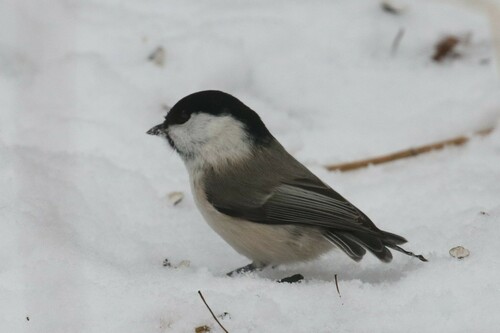 Willow Tit
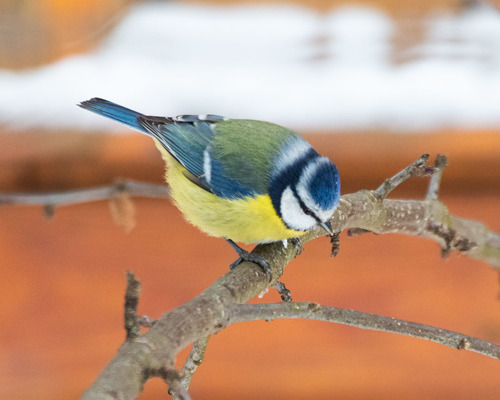 Eurasian Blue Tit
In short
The most reliable field mark to separate Willow Tit from Eurasian Blue Tit in any age or season is overall plumage color: Willow Tit is a drab, grey-brown and buff bird with a black cap and bib, while Eurasian Blue Tit is strikingly blue and yellow with a blue crown and white cheeks. Juvenile Blue Tits may appear yellower and less contrasting, but still show blue in the wings and tail, never present in Willow Tit. Willow Tit’s pale buff wing panel (edging to secondaries) can be a subtle but useful mark on perched birds. Structure and size are similar, but Blue Tit often appears more compact and active. Vocalizations are very different, and habitat overlap is broad but Willow Tit prefers damper, wooded areas.
Identification tips
- Overall color: Willow Tit is always drab grey-brown and buff with a black cap and bib; Blue Tit is blue, yellow, and white, even in juveniles.
- Blue in plumage: Any hint of blue in the crown, wings, or tail rules out Willow Tit at any age.
- Cap and face: Willow Tit’s cap is dull black (sooty, not glossy) and extends onto the nape; Blue Tit’s crown is bright blue, with a dark blue line through the eye and around the white cheeks.
- Wing panel: Willow Tit shows a pale buff patch on the closed wing (edging to secondaries), often visible when perched; Blue Tit has a white wing bar and blue wing coverts.
- Underparts: Willow Tit is buff below with rufous flanks; Blue Tit is bright yellow below with a dark line down the belly (adults), and juveniles are even more yellow.
- Back color: Willow Tit has a plain grey-brown back; Blue Tit’s back is yellowish-green.
- Bill: Willow Tit has a thin, dark bill; Blue Tit’s bill is also dark but appears stubbier due to the rounder head.
- Juvenile confusion: Juvenile Blue Tits are yellower and less contrasting, but still show blue in wings/tail; Willow Tit juveniles look like dull adults, never blue or yellow.
- Behavior: Blue Tits are acrobatic, often hanging upside-down; Willow Tits are more reserved and rarely seen at feeders.
- Habitat: Willow Tit prefers damp, young woodland, especially with birch/willow/alder; Blue Tit is common in gardens and parks.
- Voice: Willow Tit’s call is nasal and flat ("zee, zee, zee" or "ipsee, ipsee"); Blue Tit’s calls are high-pitched, thin, and more musical.
- Flight: Blue Tit often appears bouncy and energetic in flight; Willow Tit is more direct and less conspicuous.
- Sex/season: Both species are similar between sexes; Blue Tit males have brighter blue crowns under UV, but this is not visible to humans.
- Size: Not a reliable separator; both are very similar in size and mass.
- Pitfalls: In poor light or at distance, Blue Tit’s blue and yellow may appear muted, but the overall pattern (blue crown, white cheeks, yellow below) is still present. Willow Tit never shows blue or yellow in any plumage.
Size
Both species are very similar in size and mass, with Willow Tit at about 11 g and Blue Tit at 11.8 g [wikidata]. Length and wingspan overlap (Willow Tit: 11.5 cm, 17–20.5 cm; Blue Tit: 10.5–12 cm, 17.5–20 cm) [wikipedia]. In the field, size is not a reliable separator. Blue Tit may appear slightly more compact and round-headed, but this is subtle and easily misjudged.
Plumage
- Juvenile/First-year birds: Juvenile Blue Tits are yellower overall, with less contrast, but still show blue in the wings, tail, and crown. Willow Tit juveniles resemble adults: grey-brown above, buff below, with a black cap and bib, and never show blue or yellow.
- Adults: Willow Tit is plain grey-brown above, buff below, with a dull black cap extending to the nape and a black bib. The face is white, and the flanks are distinctly rufous. A pale buff panel (edging to secondaries) is visible on the closed wing. Blue Tit adults are unmistakable: blue crown, blue wings and tail, white cheeks bordered by a blue line, yellow underparts with a dark central line, and a greenish back. The white wing bar and blue tail are always present.
- Sexes: Both species are sexually similar in the field, though male Blue Tits have a brighter blue crown under UV (not visible to humans).
Behaviour
Blue Tits are acrobatic, often hanging upside-down while foraging and frequently visiting feeders and bird tables. They may peel bark or probe buds, and are rarely seen on the ground. Willow Tits are more reserved, foraging quietly in shrubs and trees, and are less likely to visit feeders. Willow Tits excavate their own nest holes in rotten wood, a behavior not seen in Blue Tits. In flight, Blue Tits can appear more energetic and bouncy, while Willow Tits are more direct and less conspicuous.
Habitat
Both species occur in woodland and edge habitats, but Willow Tit prefers damper, often wetter woodlands, young birch, alder, and willow stands, and is less common in gardens. Blue Tit is highly adaptable, found in gardens, parks, deciduous and mixed woodland, and is much more likely to be seen at feeders. Habitat alone is not diagnostic, but Willow Tit is notably scarce in urban and suburban settings where Blue Tit is abundant.
Voice
Vocalizations are very different and can be diagnostic. Willow Tit gives a nasal "zee, zee, zee" or a repeated "ipsee, ipsee" call, which is flat and lacks the musical quality of Blue Tit. Blue Tit has a wide repertoire, but typical calls are high-pitched, thin "tsee-tsee-tsee" notes and scolding, churring sounds. Blue Tit song is a rapid, high-pitched trill or series of notes, never nasal or flat like Willow Tit.