Birdr

Wilson's Phalarope vs Red-necked Phalarope

Phalaropus tricolor versus Phalaropus lobatus

Play a quiz with Wilson's Phalarope and Red-necked Phalarope
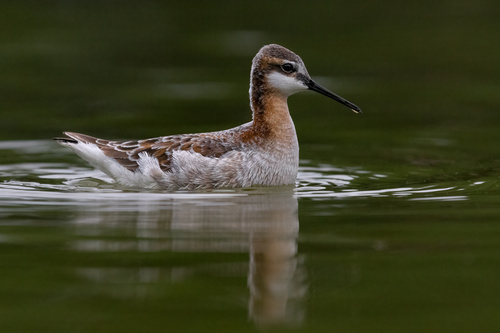
Wilson's Phalarope (Phalaropus tricolor) Wilson's Phalarope
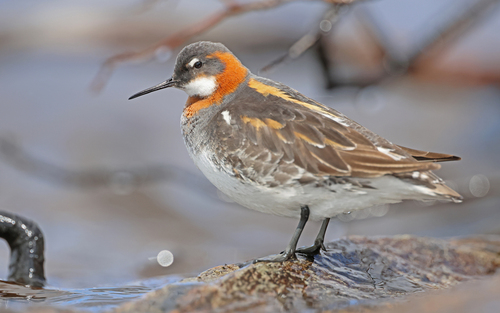
Red-necked Phalarope (Phalaropus lobatus) Red-necked Phalarope

Media

Loading…

In short

Wilson's Phalarope and Red-necked Phalarope are both small, aquatic sandpipers with slender bills and distinctive plumages. Wilson's Phalarope is best identified by its white rump and plain wings in flight, while the Red-necked Phalarope has a striking black eye-patch and is more pelagic outside the breeding season.

Identification tips

  1. In flight, look for the white rump and plain wings of Wilson's Phalarope. 2. Breeding plumage: Female Wilson's has a black stripe on the head and neck; Red-necked has a black eye-patch. 3. Nonbreeding plumage: Wilson's has yellow legs, Red-necked has black legs. 4. Habitat: Wilson's is more often in freshwater wetlands; Red-necked is pelagic.

Size

Wilson's Phalarope is slightly larger, measuring 22–24 cm in length, compared to the smaller Red-necked Phalarope.

Plumage

In breeding plumage, female Wilson's Phalaropes have a black stripe down the pale head and neck, while Red-necked Phalaropes have a black eye-patch and gray mantles. In nonbreeding plumage, Wilson's Phalaropes are plain gray above with yellow legs, whereas Red-necked Phalaropes retain their eye-patch and have shorter black legs.

Behaviour

Both species engage in spinning behavior to feed, but Red-necked Phalaropes are more often found in pelagic environments, spinning to lift planktonic prey.

Habitat

Wilson's Phalarope is often found in freshwater wetlands during migration, while Red-necked Phalarope prefers oceanic fronts and pelagic waters outside the breeding season.

Submit a better description

Use the same sections as the comparison. Your text is published immediately.

Wilson's Phalarope and Red-necked Phalarope are both small, aquatic sandpipers with slender bills and distinctive plumages. Wilson's Phalarope is best identified by its white rump and plain wings in flight, while the Red-necked Phalarope has a striking black eye-patch and is more pelagic outside the breeding season.

  1. In flight, look for the white rump and plain wings of Wilson's Phalarope. 2. Breeding plumage: Female Wilson's has a black stripe on the head and neck; Red-necked has a black eye-patch. 3. Nonbreeding plumage: Wilson's has yellow legs, Red-necked has black legs. 4. Habitat: Wilson's is more often in freshwater wetlands; Red-necked is pelagic.

Wilson's Phalarope is slightly larger, measuring 22–24 cm in length, compared to the smaller Red-necked Phalarope.

In breeding plumage, female Wilson's Phalaropes have a black stripe down the pale head and neck, while Red-necked Phalaropes have a black eye-patch and gray mantles. In nonbreeding plumage, Wilson's Phalaropes are plain gray above with yellow legs, whereas Red-necked Phalaropes retain their eye-patch and have shorter black legs.

Both species engage in spinning behavior to feed, but Red-necked Phalaropes are more often found in pelagic environments, spinning to lift planktonic prey.

Wilson's Phalarope is often found in freshwater wetlands during migration, while Red-necked Phalarope prefers oceanic fronts and pelagic waters outside the breeding season.

Discard your changes?

You have unsaved edits. If you leave now, those changes will be lost.

Wilson's Phalarope · Red-necked Phalarope · My Tricky Birds