Birdr

Wilson's Warbler vs Indigo Bunting

Cardellina pusilla versus Passerina cyanea

Play a quiz with Wilson's Warbler and Indigo Bunting
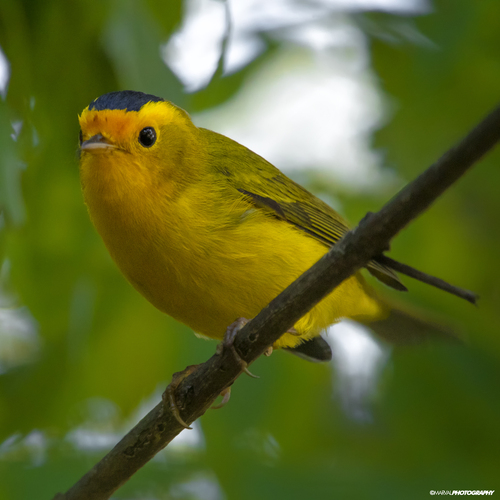
Wilson's Warbler (Cardellina pusilla) Wilson's Warbler
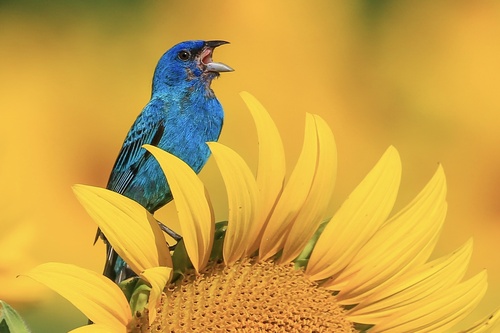
Indigo Bunting (Passerina cyanea) Indigo Bunting

Media

Loading…

In short

Wilson's Warbler is best identified by its black cap and bright yellow plumage, while the Indigo Bunting male is all blue during the breeding season. These two species differ significantly in color and habitat preferences, making them distinguishable with careful observation.

Identification tips

Size

Wilson's Warbler is smaller than the Indigo Bunting, which measures 11.5-13.0 cm in length.

Plumage

Wilson's Warbler has a bright yellow body with a distinctive black cap in males. Indigo Bunting males are entirely blue, while females and juveniles are brown with buff wing bars. The warbler's yellow and black contrast sharply with the bunting's blue or brown tones.

Behaviour

Wilson's Warbler is often seen darting through shrub willows and undergrowth, displaying characteristic tail-waving. Indigo Buntings are less active in dense undergrowth and more often seen perched in open areas.

Habitat

Wilson's Warbler prefers wet habitats with deciduous shrub thickets, often in riparian zones or wet meadows. Indigo Buntings are typically found in open woodlands, fields, and edges, preferring more open and dry habitats.

Voice

Wilson's Warbler has a short, chattering song, while the Indigo Bunting's song is a series of high-pitched notes. Their vocalizations are distinct and can aid in identification.

Submit a better description

Use the same sections as the comparison. Your text is published immediately.

Wilson's Warbler is best identified by its black cap and bright yellow plumage, while the Indigo Bunting male is all blue during the breeding season. These two species differ significantly in color and habitat preferences, making them distinguishable with careful observation.

  • Look for the black cap on Wilson's Warbler males.
  • Note the bright yellow plumage of Wilson's Warbler compared to the blue of male Indigo Buntings.
  • Observe habitat: Wilson's Warblers in dense, wet shrubbery, Indigo Buntings in open areas.
  • Listen for vocalizations: Wilson's Warbler has a chattering song, Indigo Bunting sings a series of high-pitched notes.

Wilson's Warbler is smaller than the Indigo Bunting, which measures 11.5-13.0 cm in length.

Wilson's Warbler has a bright yellow body with a distinctive black cap in males. Indigo Bunting males are entirely blue, while females and juveniles are brown with buff wing bars. The warbler's yellow and black contrast sharply with the bunting's blue or brown tones.

Wilson's Warbler is often seen darting through shrub willows and undergrowth, displaying characteristic tail-waving. Indigo Buntings are less active in dense undergrowth and more often seen perched in open areas.

Wilson's Warbler prefers wet habitats with deciduous shrub thickets, often in riparian zones or wet meadows. Indigo Buntings are typically found in open woodlands, fields, and edges, preferring more open and dry habitats.

Wilson's Warbler has a short, chattering song, while the Indigo Bunting's song is a series of high-pitched notes. Their vocalizations are distinct and can aid in identification.

Discard your changes?

You have unsaved edits. If you leave now, those changes will be lost.

Wilson's Warbler · Indigo Bunting · My Tricky Birds