
Woodlark vs Crested Lark
Lullula arborea versus Galerida cristata
Play a quiz with Woodlark and Crested Lark
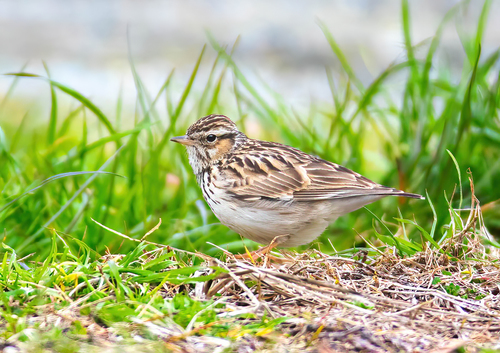 Woodlark
 Crested Lark
In short
The most reliable field mark to separate Woodlark from Crested Lark is the Woodlark’s bold, white supercilium that meets at the nape, forming a striking 'spectacle' effect, versus the Crested Lark’s plain face with no such feature. In flight, Woodlark shows a noticeably short tail with white tips but lacks the white tail sides and wing edges seen in Skylark, while Crested Lark has a short tail with light brown outer feathers and reddish underwings. The Crested Lark’s crest is always obvious, while the Woodlark’s is much smaller and often inconspicuous. Both are brown, streaky larks, but careful attention to head pattern, tail shape, and flight style will separate them in most situations, including for immatures.
Identification tips
- White supercilium meeting at nape (Woodlark): Look for the bold white eyebrow stripe that joins at the back of the head, forming a 'spectacle'—diagnostic for Woodlark of any age or season. Crested Lark lacks this feature, having a plain face.
- Crest shape and prominence: Crested Lark’s crest is long, pointed, and always obvious, especially when alert or singing. Woodlark’s crest is much smaller and usually inconspicuous, rarely raised.
- Tail length and shape in flight: Woodlark has a noticeably short tail, often making the bird look compact and stubby in flight. Crested Lark’s tail is also short but the bird appears bulkier and less compact overall.
- Tail pattern: Woodlark’s tail is tipped with white, but lacks white on the tail sides. Crested Lark’s tail has light brown outer feathers, with no strong white tips or sides.
- Underwing color in flight: Crested Lark shows reddish underwings when flying—look for this flash in good light. Woodlark’s underwings are not described as reddish.
- Facial pattern: Only Woodlark has the strong white supercilium; Crested Lark’s face is plain and earth-toned.
- Back pattern in juveniles: Juvenile Crested Larks are more spotted above than adults, but this is not a strong separator from Woodlark, which is also streaky.
- Overall jizz: Woodlark appears compact, short-tailed, and fine-billed. Crested Lark is bulkier, with a more robust head and chest, and a heavier bill.
- Bill shape: Crested Lark’s bill is heavier and more robust, especially in North African birds. Woodlark’s bill is finer and more delicate.
- Song flight style: Woodlark males flutter and spiral upward, circling as they sing. Crested Lark sings from a perch or at altitude, not during ascent, and its song flight is more undulatory.
- Song: Woodlark’s song is a fluting, repetitive 'lu-lu-lu'; Crested Lark’s is a more varied, liquid warble ('whee-whee-wheeoo'). If you hear a continuous, circling song, suspect Woodlark.
- Habitat: In open heath, pine clearings, or sandy areas, favor Woodlark. In wasteland, field edges, or urban margins, Crested Lark is more likely.
- Perched posture: Crested Lark often looks upright and alert with crest raised; Woodlark is more horizontal and inconspicuous.
- Abundance/context: In Britain and northern Europe, Woodlark is local and rare, Crested Lark is a vagrant. In southern Europe and North Africa, Crested Lark is common in disturbed habitats.
- Sex and season: No strong sexual or seasonal plumage differences in either species; all ages and sexes can be separated by the above marks.
Size
Woodlark is smaller, measuring 13.5–15 cm in length, about 20% shorter than Skylark and distinctly more compact than Crested Lark. Crested Lark is larger and bulkier, with a length of about 17 cm and a wingspan of 29–38 cm, weighing 37–55 g. In the field, Crested Lark appears heavier-bodied and more robust around the head and chest, while Woodlark is daintier and more compact overall.
Plumage
- Juvenile/immature birds: Juvenile Crested Larks have more spots on their back than adults, but this is not a strong field mark against Woodlark, which is also streaky above. The key difference is the Woodlark’s white supercilium meeting at the nape, present at all ages, and the lack of any strong facial pattern in Crested Lark.
- Adults: Woodlark is brown above, pale below, with a small, often hidden crest, and the distinctive white supercilium. In flight, Woodlark shows a short tail with white tips, but no white on the tail sides or rear wing edge. Crested Lark is also brown and streaky, but always shows a prominent, pointed crest and a plain face. Its tail is short with light brown outer feathers, and in flight, the underwings are reddish—a feature absent in Woodlark. Both lack the strong white trailing edge and tail sides of Skylark.
- Sexes: Both species are similar between sexes; no useful sexual dimorphism for field ID.
Behaviour
Woodlark males perform fluttering, spiraling song flights, circling at a fairly constant height, and both sexes may sing from the ground or a perch. Crested Lark sings in flight as well, but its display is more undulatory and it often sings from the ground or at altitude, not during ascent. Crested Lark’s crest is often raised during display or singing, making it more obvious. Both species forage on the ground, but Crested Lark is more likely to be seen in disturbed or urban edge habitats, often near roads or wasteland.
Habitat
Woodlark prefers open, sandy heaths, clearings in pine forests, and sparsely treed open spaces, especially in western and central Europe. It is less likely in urban or highly disturbed areas. Crested Lark is more of a generalist, often found in wastelands, field edges, and even on the outskirts of towns or along roadsides, especially in southern Europe and North Africa. If you see a lark in a very urban or disturbed setting, Crested Lark is more likely; in heathland or pine clearings, Woodlark is favored.
Voice
Woodlark’s song is a melodious, warbling series of repeated 'lu-lu-lu' notes, often delivered in a continuous, circling flight. Crested Lark’s song is more liquid and warbling, described as 'whee-whee-wheeoo' or 'twee-tee-too', and is usually delivered from a perch or at altitude, not during ascent. Both are accomplished songsters, but Woodlark’s song is more fluting and repetitive, while Crested Lark’s is more varied and less musical.