Birdr

Woodlark vs Eurasian Skylark

Lullula arborea versus Alauda arvensis

Play a quiz with Woodlark and Eurasian Skylark
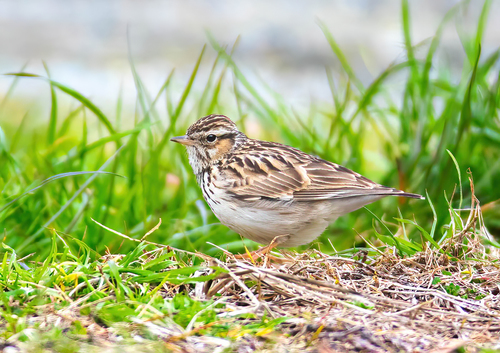
Woodlark (Lullula arborea) Woodlark
Eurasian Skylark (Alauda arvensis) Eurasian Skylark

Media

Loading…

In short

The Woodlark (Lullula arborea) and Eurasian Skylark (Alauda arvensis) are both small, brown larks, but they can be distinguished by their structure and song. The Woodlark has a distinctive short tail and a more rounded wing shape, while the Eurasian Skylark has a longer tail and wings. Both species have similar brown plumage, but their vocalizations are notably different.

Identification tips

  1. Look for the Woodlark's shorter tail and rounded wings. 2. Note the habitat: Woodlarks in woodlands, Skylarks in open fields. 3. Listen for the distinct songs: Woodlark's fluting notes vs. Skylark's continuous warble. 4. Observe flight patterns: Woodlark's undulating vs. Skylark's hovering. 5. Check for the Woodlark's more pronounced white supercilium.

Size

The Eurasian Skylark is generally larger with a longer tail compared to the more compact Woodlark.

Plumage

Both species have streaked brown plumage, but the Woodlark often appears slightly paler and has a more pronounced white supercilium.

Behaviour

Woodlarks often display a more undulating flight pattern, while Eurasian Skylarks are known for their hovering flight during song displays.

Habitat

Woodlarks prefer open woodlands and heathlands, whereas Eurasian Skylarks are more commonly found in open fields and grasslands.

Voice

The Woodlark's song is a melodious, fluting series of notes, often delivered in flight. In contrast, the Eurasian Skylark's song is a continuous, varied warble, also often sung in flight.

Submit a better description

Use the same sections as the comparison. Your text is published immediately.

The Woodlark (Lullula arborea) and Eurasian Skylark (Alauda arvensis) are both small, brown larks, but they can be distinguished by their structure and song. The Woodlark has a distinctive short tail and a more rounded wing shape, while the Eurasian Skylark has a longer tail and wings. Both species have similar brown plumage, but their vocalizations are notably different.

  1. Look for the Woodlark's shorter tail and rounded wings. 2. Note the habitat: Woodlarks in woodlands, Skylarks in open fields. 3. Listen for the distinct songs: Woodlark's fluting notes vs. Skylark's continuous warble. 4. Observe flight patterns: Woodlark's undulating vs. Skylark's hovering. 5. Check for the Woodlark's more pronounced white supercilium.

The Eurasian Skylark is generally larger with a longer tail compared to the more compact Woodlark.

Both species have streaked brown plumage, but the Woodlark often appears slightly paler and has a more pronounced white supercilium.

Woodlarks often display a more undulating flight pattern, while Eurasian Skylarks are known for their hovering flight during song displays.

Woodlarks prefer open woodlands and heathlands, whereas Eurasian Skylarks are more commonly found in open fields and grasslands.

The Woodlark's song is a melodious, fluting series of notes, often delivered in flight. In contrast, the Eurasian Skylark's song is a continuous, varied warble, also often sung in flight.

Discard your changes?

You have unsaved edits. If you leave now, those changes will be lost.

Woodlark · Eurasian Skylark · My Tricky Birds