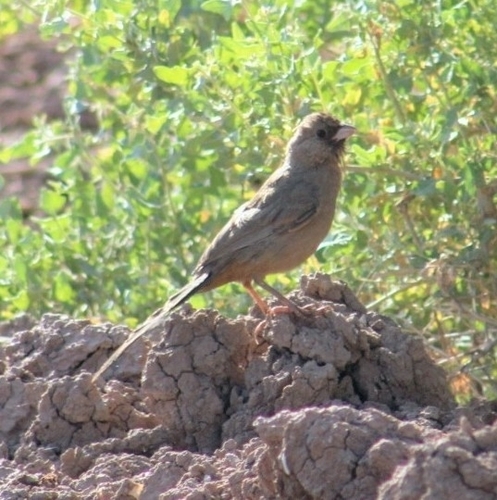
Wrentit vs Abert's Towhee
Chamaea fasciata versus Melozone aberti
Play a quiz with Wrentit and Abert's Towhee
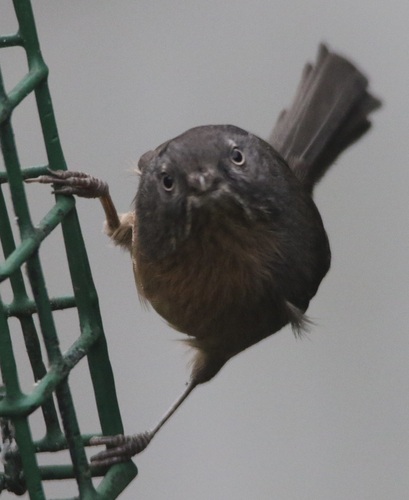
Wrentit
Abert's Towhee
In short
The Wrentit and Abert's Towhee can be distinguished by their size, habitat preference, and behavior. Wrentits are smaller, more arboreal, and often found in dense shrubbery, while Abert's Towhees are larger, ground-foraging birds common in open, arid environments.
Identification tips
- Size and Shape: Note the smaller, more compact size of the Wrentit compared to the larger Abert's Towhee.
- Habitat: Look for Wrentits in dense shrubs and chaparral, while Abert's Towhees are more likely in open, arid areas.
- Behavior: Observe the arboreal habits of Wrentits versus the ground-foraging behavior of Abert's Towhees.
- Vocalizations: Listen for the Wrentit's distinctive song compared to the Abert's Towhee's squeal duet.
Size
Wrentits are smaller and more compact than Abert's Towhees, which are larger and have a more robust build.
Plumage
Wrentits have a uniform grayish-brown plumage with a subtle, barred pattern on the wings and tail. Abert's Towhees are also brown but have a more uniform color with a slightly reddish undertone, especially on the undertail coverts.
Behaviour
Wrentits are more arboreal, often seen flitting through dense shrubs. In contrast, Abert's Towhees are ground foragers, spending most of their time scratching for food on the ground.
Habitat
Wrentits prefer dense shrubbery and chaparral, often in coastal or riparian areas. Abert's Towhees are typically found in arid, open environments, including desert washes and suburban areas.
Voice
Wrentits are known for their distinctive song, often described as 'the voice of the chaparral,' while Abert's Towhees are less vocal, with their most characteristic sound being a squeal duet given by pairs.