Birdr

Yellow-billed Cuckoo vs Black-billed Cuckoo

Coccyzus americanus versus Coccyzus erythropthalmus

Play a quiz with Yellow-billed Cuckoo and Black-billed Cuckoo
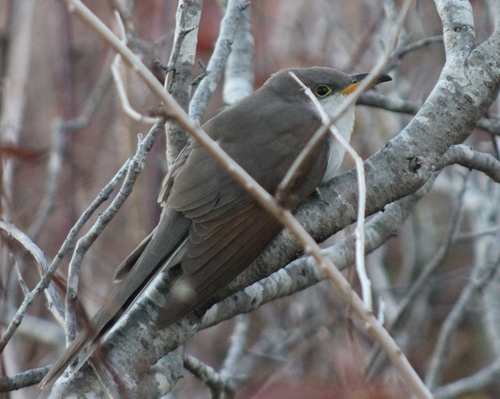
Yellow-billed Cuckoo (Coccyzus americanus) Yellow-billed Cuckoo
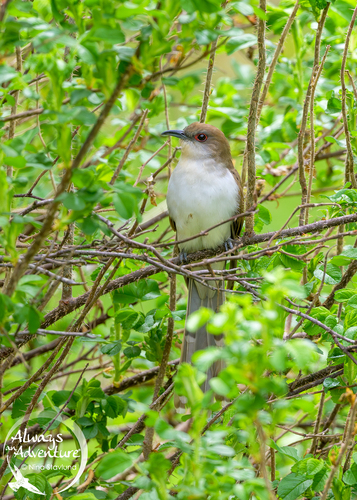
Black-billed Cuckoo (Coccyzus erythropthalmus) Black-billed Cuckoo

Media

Loading…

In short

The Yellow-billed Cuckoo (Coccyzus americanus) and Black-billed Cuckoo (Coccyzus erythropthalmus) can be distinguished primarily by their bill color and habitat preference. The Yellow-billed Cuckoo has a yellow lower mandible, while the Black-billed Cuckoo has an entirely dark bill. Both species are secretive, but the Black-billed Cuckoo is more associated with densely wooded and coniferous habitats.

Identification tips

Size

Both species are similar in size, with slender bodies typical of cuckoos.

Plumage

The Yellow-billed Cuckoo has a yellow lower mandible, while the Black-billed Cuckoo has a completely dark bill. Both have similar overall plumage, with brown upperparts and white underparts, but the Yellow-billed Cuckoo may show more rufous in the wings.

Behaviour

Both species exhibit secretive behavior and are known for their rapid breeding cycles. The Yellow-billed Cuckoo is more often seen during the day, while the Black-billed Cuckoo may be partially nocturnal.

Habitat

The Yellow-billed Cuckoo is found in a variety of habitats, including open woodlands and riparian areas. In contrast, the Black-billed Cuckoo prefers densely wooded habitats, often with coniferous vegetation.

Voice

The Black-billed Cuckoo has a distinctive staccato call, 'cu-cu-cu cu-cu-cu', often heard during late spring evenings. The Yellow-billed Cuckoo's call is a series of soft 'coo' notes, but is less distinctive than the Black-billed's call.

Submit a better description

Use the same sections as the comparison. Your text is published immediately.

The Yellow-billed Cuckoo (Coccyzus americanus) and Black-billed Cuckoo (Coccyzus erythropthalmus) can be distinguished primarily by their bill color and habitat preference. The Yellow-billed Cuckoo has a yellow lower mandible, while the Black-billed Cuckoo has an entirely dark bill. Both species are secretive, but the Black-billed Cuckoo is more associated with densely wooded and coniferous habitats.

  • Bill color: Look for the yellow lower mandible in Yellow-billed Cuckoo; Black-billed has a dark bill.
  • Habitat: Note the habitat; Black-billed prefers dense, wooded areas, often with conifers.
  • Vocalization: Listen for the Black-billed's staccato call during late spring evenings.
  • Plumage: Check for more rufous in the wings of Yellow-billed Cuckoo.

Both species are similar in size, with slender bodies typical of cuckoos.

The Yellow-billed Cuckoo has a yellow lower mandible, while the Black-billed Cuckoo has a completely dark bill. Both have similar overall plumage, with brown upperparts and white underparts, but the Yellow-billed Cuckoo may show more rufous in the wings.

Both species exhibit secretive behavior and are known for their rapid breeding cycles. The Yellow-billed Cuckoo is more often seen during the day, while the Black-billed Cuckoo may be partially nocturnal.

The Yellow-billed Cuckoo is found in a variety of habitats, including open woodlands and riparian areas. In contrast, the Black-billed Cuckoo prefers densely wooded habitats, often with coniferous vegetation.

The Black-billed Cuckoo has a distinctive staccato call, 'cu-cu-cu cu-cu-cu', often heard during late spring evenings. The Yellow-billed Cuckoo's call is a series of soft 'coo' notes, but is less distinctive than the Black-billed's call.

Discard your changes?

You have unsaved edits. If you leave now, those changes will be lost.

Yellow-billed Cuckoo · Black-billed Cuckoo · My Tricky Birds