Birdr

Yellow-billed Cuckoo vs Common Cuckoo

Coccyzus americanus versus Cuculus canorus

Play a quiz with Yellow-billed Cuckoo and Common Cuckoo
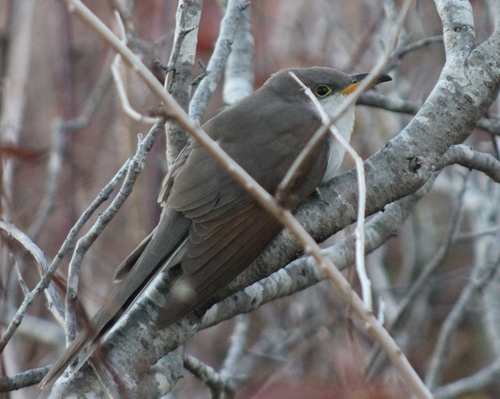
Yellow-billed Cuckoo (Coccyzus americanus) Yellow-billed Cuckoo
Common Cuckoo (Cuculus canorus) Common Cuckoo

Media

Loading…

In short

The Yellow-billed Cuckoo (Coccyzus americanus) is best identified by its distinctive yellow lower mandible, while the Common Cuckoo (Cuculus canorus) has a uniformly dark bill. Both species are similar in size and shape, but their vocalizations and behaviors differ significantly.

Identification tips

  1. Look for the yellow lower mandible on the Yellow-billed Cuckoo. 2. Note the tail pattern: Yellow-billed has bold white spots, while Common has a more uniform tail. 3. Listen for vocalizations: Yellow-billed has a soft 'coo', Common has a loud 'cuck-oo'. 4. Observe behavior: Yellow-billed may be seen in dense foliage, while Common often perches in the open.

Size

Both species are similar in size, with slender bodies and long tails typical of cuckoos.

Plumage

The Yellow-billed Cuckoo has a mostly brown upper body with white underparts and a bold white tail pattern. The Common Cuckoo is more uniformly gray with a barred underbelly.

Behaviour

Yellow-billed Cuckoos are known for their rapid breeding cycle and facultative brood parasitism, often using nests of other bird species. Common Cuckoos are obligate brood parasites, laying eggs in the nests of other birds without building their own.

Habitat

Yellow-billed Cuckoos are typically found in deciduous woodlands and riparian areas in North America, while Common Cuckoos inhabit a wide range of habitats across Europe and Asia, including open woodlands and farmlands.

Voice

The Yellow-billed Cuckoo's call is a series of soft, repetitive 'coo' sounds, whereas the Common Cuckoo is famous for its distinctive 'cuck-oo' call.

Submit a better description

Use the same sections as the comparison. Your text is published immediately.

The Yellow-billed Cuckoo (Coccyzus americanus) is best identified by its distinctive yellow lower mandible, while the Common Cuckoo (Cuculus canorus) has a uniformly dark bill. Both species are similar in size and shape, but their vocalizations and behaviors differ significantly.

  1. Look for the yellow lower mandible on the Yellow-billed Cuckoo. 2. Note the tail pattern: Yellow-billed has bold white spots, while Common has a more uniform tail. 3. Listen for vocalizations: Yellow-billed has a soft 'coo', Common has a loud 'cuck-oo'. 4. Observe behavior: Yellow-billed may be seen in dense foliage, while Common often perches in the open.

Both species are similar in size, with slender bodies and long tails typical of cuckoos.

The Yellow-billed Cuckoo has a mostly brown upper body with white underparts and a bold white tail pattern. The Common Cuckoo is more uniformly gray with a barred underbelly.

Yellow-billed Cuckoos are known for their rapid breeding cycle and facultative brood parasitism, often using nests of other bird species. Common Cuckoos are obligate brood parasites, laying eggs in the nests of other birds without building their own.

Yellow-billed Cuckoos are typically found in deciduous woodlands and riparian areas in North America, while Common Cuckoos inhabit a wide range of habitats across Europe and Asia, including open woodlands and farmlands.

The Yellow-billed Cuckoo's call is a series of soft, repetitive 'coo' sounds, whereas the Common Cuckoo is famous for its distinctive 'cuck-oo' call.

Discard your changes?

You have unsaved edits. If you leave now, those changes will be lost.

Yellow-billed Cuckoo · Common Cuckoo · My Tricky Birds