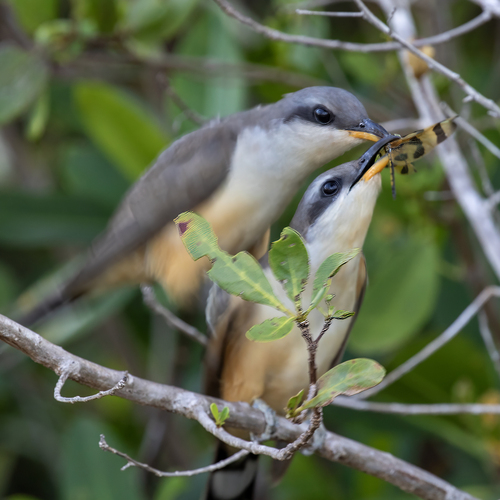
Yellow-billed Cuckoo vs Mangrove Cuckoo
Coccyzus americanus versus Coccyzus minor
Play a quiz with Yellow-billed Cuckoo and Mangrove Cuckoo
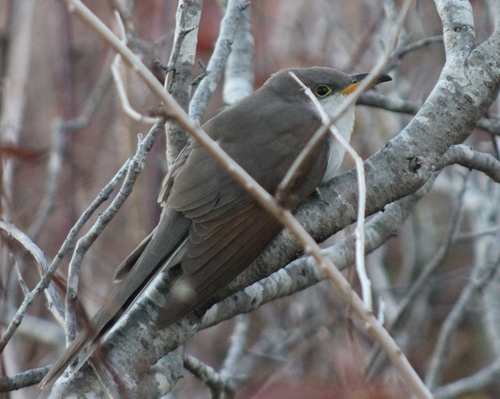
Yellow-billed Cuckoo
Mangrove Cuckoo
In short
To distinguish between the Yellow-billed Cuckoo and the Mangrove Cuckoo, focus on the bill color and tail pattern. The Yellow-billed Cuckoo has a yellow lower mandible and a distinctive white-edged tail, while the Mangrove Cuckoo features a black upper mandible with an orange-yellow base and a tail with white tips on both webs.
Identification tips
- Bill Color: Yellow-billed Cuckoo has a yellow lower mandible; Mangrove Cuckoo has a black upper mandible with an orange-yellow base.
- Tail Pattern: Yellow-billed Cuckoo's tail has white tips on the outer web; Mangrove Cuckoo's tail has white tips on both webs.
- Crown and Mask: Mangrove Cuckoo has a grayish crown and black auricular patch, which the Yellow-billed lacks.
- Flight: Look for the cinnamon rufous color on the inner webs of the Yellow-billed Cuckoo's primaries.
- Voice: Listen for the slower, lower-pitched calls of the Mangrove Cuckoo.
Size
The Yellow-billed Cuckoo is slightly smaller, measuring 26–30 cm in length, compared to the Mangrove Cuckoo's 28–32 cm.
Plumage
The Yellow-billed Cuckoo lacks the Mangrove Cuckoo's grayish crown and black auricular patch. The Yellow-billed has a cinnamon rufous color on the inner webs of primaries visible in flight, whereas the Mangrove has buffy underparts.
Habitat
Both species can be found in overlapping ranges in Florida, the Caribbean, and Mexico, but the Mangrove Cuckoo is more associated with mangrove habitats.
Voice
The Mangrove Cuckoo's calls are generally lower-pitched and slower than the Yellow-billed Cuckoo's.