Birdr

Yellow-breasted Pipit vs Yellow-throated Longclaw

Hemimacronyx chloris versus Macronyx croceus

Play a quiz with Yellow-breasted Pipit and Yellow-throated Longclaw
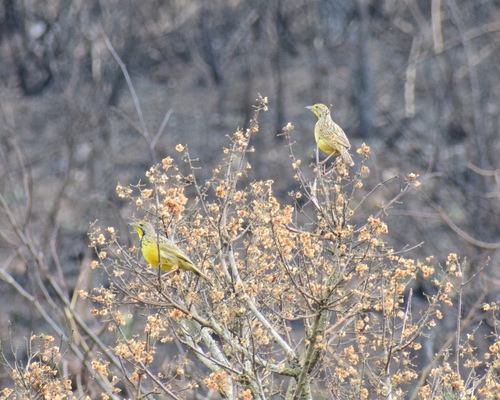
Yellow-breasted Pipit (Hemimacronyx chloris) Yellow-breasted Pipit
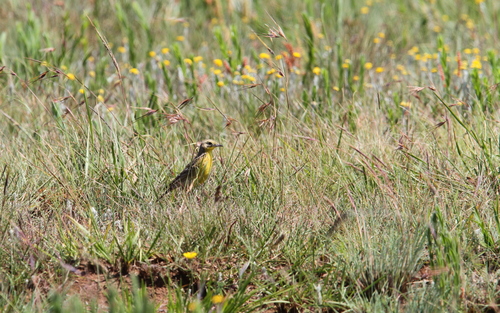
Yellow-throated Longclaw (Macronyx croceus) Yellow-throated Longclaw

Media

Loading…

In short

The Yellow-breasted Pipit and Yellow-throated Longclaw can be distinguished primarily by their structure and plumage. The pipit has a more slender build with a finer bill, while the longclaw is more robust with a thicker bill. The longclaw's bright yellow throat and chest with a distinct black necklace are key identifiers.

Identification tips

  1. Look for the black necklace on the Yellow-throated Longclaw. 2. Note the bill size: the pipit has a finer bill. 3. Observe the habitat: pipits are more likely in high-altitude grasslands. 4. Consider size: longclaws are generally larger and more robust.

Size

The Yellow-throated Longclaw is generally larger and more robust than the Yellow-breasted Pipit.

Plumage

The Yellow-breasted Pipit has a yellow breast with streaking, whereas the Yellow-throated Longclaw has a bright yellow throat and chest with a prominent black necklace. The pipit is more uniformly streaked on the back, while the longclaw has a more contrasting back pattern.

Behaviour

Both species exhibit similar ground-foraging behavior typical of pipits and longclaws, but the longclaw may be more conspicuous due to its striking plumage.

Habitat

The Yellow-breasted Pipit is typically found in high-altitude grasslands, while the Yellow-throated Longclaw prefers savannas and open fields.

Voice

Vocalizations are not the most reliable distinguishing feature, but the Yellow-throated Longclaw's song is often described as more melodic compared to the pipit's simpler calls.

Submit a better description

Use the same sections as the comparison. Your text is published immediately.

The Yellow-breasted Pipit and Yellow-throated Longclaw can be distinguished primarily by their structure and plumage. The pipit has a more slender build with a finer bill, while the longclaw is more robust with a thicker bill. The longclaw's bright yellow throat and chest with a distinct black necklace are key identifiers.

  1. Look for the black necklace on the Yellow-throated Longclaw. 2. Note the bill size: the pipit has a finer bill. 3. Observe the habitat: pipits are more likely in high-altitude grasslands. 4. Consider size: longclaws are generally larger and more robust.

The Yellow-throated Longclaw is generally larger and more robust than the Yellow-breasted Pipit.

The Yellow-breasted Pipit has a yellow breast with streaking, whereas the Yellow-throated Longclaw has a bright yellow throat and chest with a prominent black necklace. The pipit is more uniformly streaked on the back, while the longclaw has a more contrasting back pattern.

Both species exhibit similar ground-foraging behavior typical of pipits and longclaws, but the longclaw may be more conspicuous due to its striking plumage.

The Yellow-breasted Pipit is typically found in high-altitude grasslands, while the Yellow-throated Longclaw prefers savannas and open fields.

Vocalizations are not the most reliable distinguishing feature, but the Yellow-throated Longclaw's song is often described as more melodic compared to the pipit's simpler calls.

Discard your changes?

You have unsaved edits. If you leave now, those changes will be lost.

Yellow-breasted Pipit · Yellow-throated Longclaw · My Tricky Birds