
Birdr

Yellow-browed Bunting vs Dark-eyed Junco

Emberiza chrysophrys versus Junco hyemalis

Play a quiz with Yellow-browed Bunting and Dark-eyed Junco
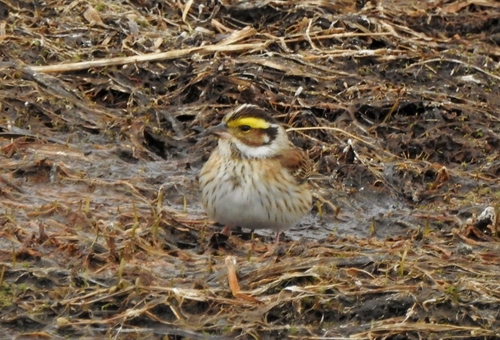
Yellow-browed Bunting (Emberiza chrysophrys) Yellow-browed Bunting
Dark-eyed Junco (Junco hyemalis) Dark-eyed Junco

Media

Loading…

In short

The Yellow-browed Bunting and Dark-eyed Junco are distinct in appearance and habitat preferences. The Yellow-browed Bunting is notable for its bright yellow eyebrow stripe, while the Dark-eyed Junco is recognized by its white outer tail feathers and contrasting hood. Both species occupy different geographic ranges, with the bunting in Asia and the junco in North America.

Identification tips

  1. Look for the yellow eyebrow stripe on the Yellow-browed Bunting. 2. Check for the white outer tail feathers and hood of the Dark-eyed Junco. 3. Consider habitat: buntings in Asia, juncos in North America. 4. Listen for vocal differences: melodic bunting vs. trilling junco.

Size

Both species are small passerines, but the Dark-eyed Junco is generally slightly larger and stockier than the Yellow-browed Bunting.

Plumage

The Yellow-browed Bunting has a distinctive yellow eyebrow stripe and a more streaked appearance overall. In contrast, the Dark-eyed Junco shows a gray or blackish hood with a whitish belly and prominent white outer tail feathers visible in flight.

Behaviour

The Dark-eyed Junco often forages on the ground and is known for its hopping behavior. The Yellow-browed Bunting also forages on the ground but is less commonly observed in open areas compared to the junco.

Habitat

Yellow-browed Buntings prefer forested and shrubby areas in Asia, while Dark-eyed Juncos are found in a variety of habitats across North America, including forests, fields, and urban areas.

Voice

The vocalizations of these species differ significantly, with the Yellow-browed Bunting having a more melodic song compared to the simpler trill of the Dark-eyed Junco.

Submit a better description

Use the same sections as the comparison. Your text is published immediately.

The Yellow-browed Bunting and Dark-eyed Junco are distinct in appearance and habitat preferences. The Yellow-browed Bunting is notable for its bright yellow eyebrow stripe, while the Dark-eyed Junco is recognized by its white outer tail feathers and contrasting hood. Both species occupy different geographic ranges, with the bunting in Asia and the junco in North America.

  1. Look for the yellow eyebrow stripe on the Yellow-browed Bunting. 2. Check for the white outer tail feathers and hood of the Dark-eyed Junco. 3. Consider habitat: buntings in Asia, juncos in North America. 4. Listen for vocal differences: melodic bunting vs. trilling junco.

Both species are small passerines, but the Dark-eyed Junco is generally slightly larger and stockier than the Yellow-browed Bunting.

The Yellow-browed Bunting has a distinctive yellow eyebrow stripe and a more streaked appearance overall. In contrast, the Dark-eyed Junco shows a gray or blackish hood with a whitish belly and prominent white outer tail feathers visible in flight.

The Dark-eyed Junco often forages on the ground and is known for its hopping behavior. The Yellow-browed Bunting also forages on the ground but is less commonly observed in open areas compared to the junco.

Yellow-browed Buntings prefer forested and shrubby areas in Asia, while Dark-eyed Juncos are found in a variety of habitats across North America, including forests, fields, and urban areas.

The vocalizations of these species differ significantly, with the Yellow-browed Bunting having a more melodic song compared to the simpler trill of the Dark-eyed Junco.

Discard your changes?

You have unsaved edits. If you leave now, those changes will be lost.

Yellow-browed Bunting · Dark-eyed Junco · My Tricky Birds