Birdr

Yellow-crested Tanager vs White-shouldered Tanager

Loriotus rufiventer versus Loriotus luctuosus

Play a quiz with Yellow-crested Tanager and White-shouldered Tanager
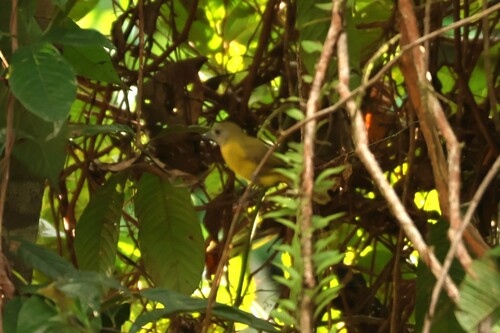
Yellow-crested Tanager (Loriotus rufiventer) Yellow-crested Tanager
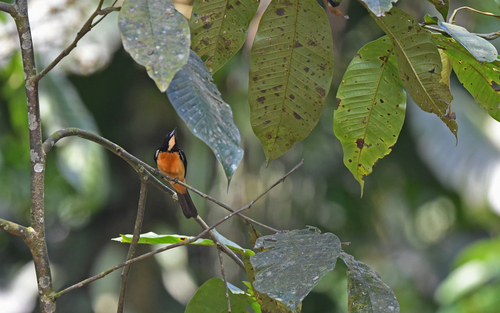
White-shouldered Tanager (Loriotus luctuosus) White-shouldered Tanager

Media

Loading…

In short

The Yellow-crested Tanager and White-shouldered Tanager are both small, colorful tanagers, but they can be distinguished by their distinct male plumage: the Yellow-crested Tanager male has a conspicuous yellow crown, while the White-shouldered Tanager male is jet black with obvious white shoulders. Females of both species are more similar, with olive-green backs and yellowish underparts, but differ in head and throat coloration.

Identification tips

  1. Look for the yellow crown on male Yellow-crested Tanagers. 2. Identify male White-shouldered Tanagers by their jet black plumage with white shoulders. 3. Note the gray head on female White-shouldered Tanagers, contrasting with the whitish throat of female Yellow-crested Tanagers. 4. Listen for the short, high, rising notes of the White-shouldered Tanager.

Size

Both species are similar in size, typical of small tanagers.

Plumage

Male Yellow-crested Tanagers have a striking yellow crown, while males of the White-shouldered Tanager are jet black with prominent white shoulder patches. Female Yellow-crested Tanagers are olive above with a whitish throat and ochraceous yellow underparts, whereas female White-shouldered Tanagers have an olive-green back, yellow belly, gray head, and whitish throat.

Behaviour

Both species forage in flocks, often at midlevels, but also in the subcanopy and lower growth. They glean and flutter for insects and small fruit.

Habitat

Both species are found in similar habitats, typically in forested areas, but specific habitat preferences are not detailed in the sources.

Voice

The White-shouldered Tanager's calls are a series of short, high, rising notes, which are constant but easily overlooked. Vocalizations of the Yellow-crested Tanager are not detailed in the sources.

Submit a better description

Use the same sections as the comparison. Your text is published immediately.

The Yellow-crested Tanager and White-shouldered Tanager are both small, colorful tanagers, but they can be distinguished by their distinct male plumage: the Yellow-crested Tanager male has a conspicuous yellow crown, while the White-shouldered Tanager male is jet black with obvious white shoulders. Females of both species are more similar, with olive-green backs and yellowish underparts, but differ in head and throat coloration.

  1. Look for the yellow crown on male Yellow-crested Tanagers. 2. Identify male White-shouldered Tanagers by their jet black plumage with white shoulders. 3. Note the gray head on female White-shouldered Tanagers, contrasting with the whitish throat of female Yellow-crested Tanagers. 4. Listen for the short, high, rising notes of the White-shouldered Tanager.

Both species are similar in size, typical of small tanagers.

Male Yellow-crested Tanagers have a striking yellow crown, while males of the White-shouldered Tanager are jet black with prominent white shoulder patches. Female Yellow-crested Tanagers are olive above with a whitish throat and ochraceous yellow underparts, whereas female White-shouldered Tanagers have an olive-green back, yellow belly, gray head, and whitish throat.

Both species forage in flocks, often at midlevels, but also in the subcanopy and lower growth. They glean and flutter for insects and small fruit.

Both species are found in similar habitats, typically in forested areas, but specific habitat preferences are not detailed in the sources.

The White-shouldered Tanager's calls are a series of short, high, rising notes, which are constant but easily overlooked. Vocalizations of the Yellow-crested Tanager are not detailed in the sources.

Discard your changes?

You have unsaved edits. If you leave now, those changes will be lost.

Yellow-crested Tanager · White-shouldered Tanager · My Tricky Birds