
Yellow-crowned Night Heron vs Black-crowned Night Heron
Nyctanassa violacea versus Nycticorax nycticorax
Play a quiz with Yellow-crowned Night Heron and Black-crowned Night Heron
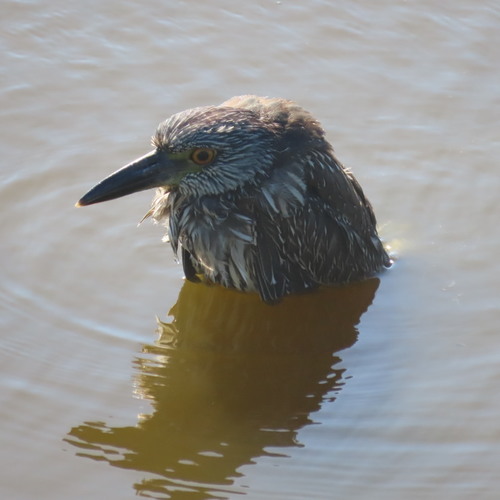 Yellow-crowned Night Heron
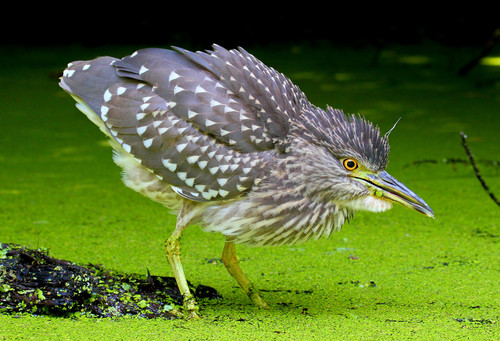 Black-crowned Night Heron
In short
Juvenile Yellow-crowned and Black-crowned Night Herons are notoriously similar, but careful attention to head and bill shape, leg length, and the pattern and fineness of spots and streaks can separate them. Adult birds are more straightforward: Yellow-crowned shows a striking black-and-white face with a pale yellow crown, while Black-crowned has a solid black cap and back with pale grey wings and white underparts. Structure is also useful—Yellow-crowned is longer-legged and heavier-billed, often standing more upright. Both species may show courtship-related color changes in the legs and head plumes, but these differ in detail. Field separation is most challenging with immatures, especially in flight, so focus on the most consistent structural and plumage marks.
Identification tips
- Juvenile wing and back pattern: Look for the size and shape of pale spots—Yellow-crowned has finer, narrower streaks and spots, while Black-crowned shows larger, rounded 'teardrop' spots. This is most useful in fresh juveniles and first-winter birds.
- Head and face pattern (adults): Adult Yellow-crowned has a distinctive pale yellow crown stripe and a horizontally striped black-white-black-white face; Black-crowned has a solid black cap and white to pale grey face without strong striping.
- Bill shape: Yellow-crowned of all ages has a heavier, deeper bill, especially noticeable in profile. Black-crowned's bill is shorter and more tapered.
- Leg length and color: Yellow-crowned's legs are longer and yellow (turning coral/pink/red in courtship); Black-crowned's legs are shorter and yellowish, turning salmon-pink in breeding season. This is most obvious when birds are standing or wading.
- Posture and jizz: Yellow-crowned often stands tall and straight, especially when alert; Black-crowned is more likely to appear hunched, with a shorter neck and compact body.
- Eye color: Both species have red or orange eyes as adults, but juveniles of Black-crowned have orange eyes, while Yellow-crowned's are darker.
- Head plumes (breeding adults): Both species grow long white plumes in courtship, but Yellow-crowned's plumes are thinner and extend from the crown, while Black-crowned's are from the back of the head.
- Underpart color (adults): Black-crowned has white underparts; Yellow-crowned is more uniform grey-blue below.
- Upperwing pattern in flight (juveniles): If visible, check for the finer, more evenly distributed spots of Yellow-crowned versus the larger, more irregular pale spots of Black-crowned.
- Habitat context: In coastal saltmarshes or crab-rich tidal flats, Yellow-crowned is more likely; in inland wetlands, Black-crowned is more expected, though both can overlap.
- Behavior at rest: Yellow-crowned is often seen standing in the open, sometimes on exposed perches; Black-crowned prefers to roost in dense cover and is less conspicuous by day.
- Courtship color changes: Both species' legs change color in breeding season, but the shades differ (coral/pink/red in Yellow-crowned, salmon-pink in Black-crowned), and the bare skin around the eyes of Black-crowned turns blue.
- Age progression: Both species take several years to reach adult plumage, but Yellow-crowned remains more finely marked and upright throughout immaturity.
- Geographic range: Black-crowned is widespread globally; Yellow-crowned is restricted to the Americas. In Eurasia or Africa, a night heron is almost certainly Black-crowned.
- Plumage pitfalls: Immature birds of both species can be very similar—use a combination of structure, spot pattern, and habitat for best results. No single mark is foolproof in all conditions, especially at a distance or in poor light.
Size
Adult Black-crowned Night Herons are slightly heavier on average (body mass ~636g [wikidata]), and appear stockier with shorter legs and a shorter, thicker neck. Yellow-crowned Night Herons are a bit slimmer, with longer legs and a heavier, deeper bill. In the field, Yellow-crowned often looks taller and more upright, while Black-crowned appears more compact and hunched, especially when perched.
Plumage
For juveniles and immatures (the most frequent source of confusion):
- Juvenile Yellow-crowned Night Heron: Shows a brownish body with fine, narrow pale spots and streaks, especially on the wings and back. The head is overall greyish and drab, lacking strong contrast. The bill is heavy and deep, and the legs are relatively long and yellowish. Stance is often more upright.
- Juvenile Black-crowned Night Heron: Duller grey-brown overall, with larger, more rounded pale 'teardrop' spots on the wings and back. Underparts are paler and streaked with brown. The bill is shorter and less deep, and the legs are shorter and yellowish-green. The posture is typically more hunched.
Adults are much easier:
- Adult Yellow-crowned Night Heron: Smooth grey-blue body and back with black-scaled wing pattern. Head is black and glossy with white cheeks and a pale yellow crown stripe, creating a horizontally striped black-white-black-white face. Long, thin white plumes extend from the crown in breeding season. Bill is black and thick; eyes are dark orange or red; legs yellow (turning coral, pink, or red in courtship).
- Adult Black-crowned Night Heron: Black crown and back, pale grey wings, and white underparts. Eyes are red, legs short and yellow (turning salmon-pink in courtship), and two to four long white plumes extend from the back of the head in breeding season. The face lacks the striped pattern of Yellow-crowned, instead showing a solid black cap.
Second and third year birds of both species show intermediate plumages, gradually approaching adult appearance but lacking full head plumes and crisp contrasts.
Behaviour
Yellow-crowned Night Herons tend to stand more upright and appear longer-legged, especially when alert or foraging. Black-crowned Night Herons are more likely to be seen in a hunched posture, with the neck retracted and body appearing compact. Both species are crepuscular or nocturnal, often roosting during the day and feeding at dusk or night. In flight, Yellow-crowned may look slightly longer and more angular due to leg and bill proportions, but this is subtle.
Habitat
Both species can be found in wetland habitats, but Yellow-crowned Night Herons are more closely associated with coastal areas, saltmarshes, and habitats where crabs and crustaceans are abundant. Black-crowned Night Herons have a much broader range, including inland wetlands, lakes, rivers, and even urban parks. In the Americas, both can overlap, but context may help: Yellow-crowned is more likely in tidal and brackish environments.
Yellow-crowned Night Heron · Black-crowned Night Heron · My Tricky Birds