Birdr

Yellow-rumped Flycatcher vs Mugimaki Flycatcher

Ficedula zanthopygia versus Ficedula mugimaki

Play a quiz with Yellow-rumped Flycatcher and Mugimaki Flycatcher
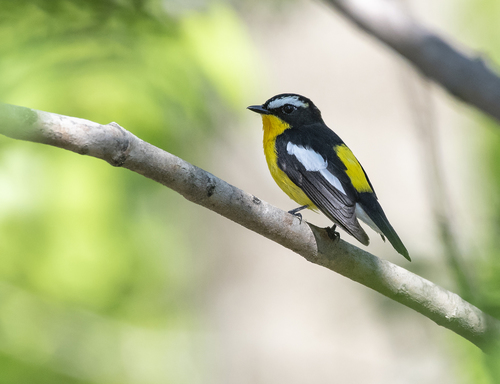
Yellow-rumped Flycatcher (Ficedula zanthopygia) Yellow-rumped Flycatcher
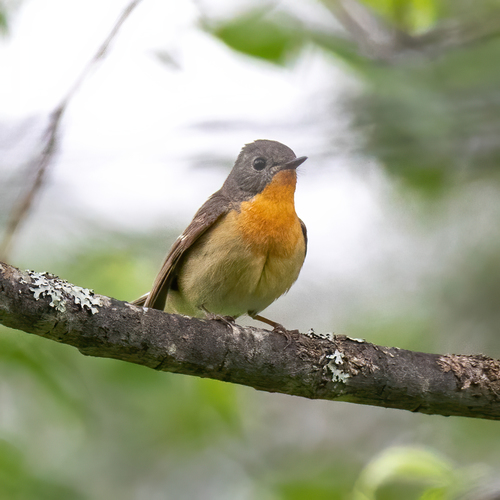
Mugimaki Flycatcher (Ficedula mugimaki) Mugimaki Flycatcher

Media

Loading…

In short

The Yellow-rumped Flycatcher can be distinguished from the Mugimaki Flycatcher by its bright yellow rump and lack of a white supercilium. Both species are small, active flycatchers with similar structure, but the Mugimaki Flycatcher has a more pronounced white supercilium and orange throat, which are key distinguishing features.

Identification tips

Size

Both species are similar in size, typical of small flycatchers, with no significant difference in structure.

Plumage

The Yellow-rumped Flycatcher has a bright yellow rump and underparts, contrasting with its black upperparts and head. The Mugimaki Flycatcher features an orange throat and breast, with a prominent white supercilium and black upperparts. The Mugimaki's white wing patch is also a notable feature.

Behaviour

Both species exhibit typical flycatcher behavior, actively sallying for insects. There are no significant behavioral differences noted in the field.

Habitat

Both species inhabit forested areas, but the Yellow-rumped Flycatcher is more often found in lowland forests, while the Mugimaki Flycatcher can be found in both lowland and montane forests during migration.

Voice

Vocalizations are not a primary distinguishing feature in the field, as both species have simple calls typical of flycatchers. Specific differences in song are not well-documented for field identification.

Submit a better description

Use the same sections as the comparison. Your text is published immediately.

The Yellow-rumped Flycatcher can be distinguished from the Mugimaki Flycatcher by its bright yellow rump and lack of a white supercilium. Both species are small, active flycatchers with similar structure, but the Mugimaki Flycatcher has a more pronounced white supercilium and orange throat, which are key distinguishing features.

  • Yellow-rumped Flycatcher: Look for the bright yellow rump and underparts, contrasting with black upperparts. Absence of a white supercilium.
  • Mugimaki Flycatcher: Note the orange throat and breast, prominent white supercilium, and white wing patch.
  • Consider habitat: Yellow-rumped Flycatchers are more common in lowland forests, while Mugimaki Flycatchers may be found in a wider range of forested habitats during migration.

Both species are similar in size, typical of small flycatchers, with no significant difference in structure.

The Yellow-rumped Flycatcher has a bright yellow rump and underparts, contrasting with its black upperparts and head. The Mugimaki Flycatcher features an orange throat and breast, with a prominent white supercilium and black upperparts. The Mugimaki's white wing patch is also a notable feature.

Both species exhibit typical flycatcher behavior, actively sallying for insects. There are no significant behavioral differences noted in the field.

Both species inhabit forested areas, but the Yellow-rumped Flycatcher is more often found in lowland forests, while the Mugimaki Flycatcher can be found in both lowland and montane forests during migration.

Vocalizations are not a primary distinguishing feature in the field, as both species have simple calls typical of flycatchers. Specific differences in song are not well-documented for field identification.

Discard your changes?

You have unsaved edits. If you leave now, those changes will be lost.

Yellow-rumped Flycatcher · Mugimaki Flycatcher · My Tricky Birds